


The Foundation
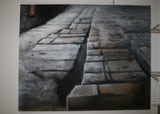
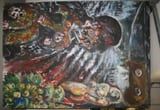
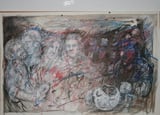
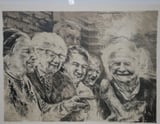
The Foundation focuses on cultural exchange and the preservation as well as reappraisal of the visual arts of the 70s/80s.
It initiates and supports projects on application without thematic limitation in all fields dealing with the art of these years. In particular, the foundation maintains the estates as well as the current works of the members of the artist group RATGEB Berlin 1977–1985.
The foundation was established in Berlin in 2021.
Purpose of the foundation
The purpose of the Foundation is the promotion of art, culture and education in accordance with Sections 52 et seq. of the German Fiscal Code (AO). The Foundation's purpose is realised in particular through:
Building a collection of contemporary art with a focus on art that advances social discourse and is to be made accessible to the public
Organising solo and group exhibitions, cataloguing and publishing artistic works
More about the founder
Michael Thomas Schröder, Chairman of the Foundation, born 1949 in Berlin.
Michael Thomas Schröder, born 1949 in Berlin, founded the Galerie 70 in Berlin-Charlottenburg, Schillerstrasse 70, together with friends in 1977, which in turn was the center of Berlin’s political cultural scene until its closure in 1986. In addition to political-documentary exhibitions on topics such as “Brokdorf”, “§ 218”, “Kunst gegen Rechts”, “SPIEGEL-Titelseiten”, “Kriegsspielzeug”, “Kein schöner Land”, there were various joint political art projects with the artist group RATGEB, such as “Fussball & Folter” (Football & Torture) on the occasion of the World Cup in Argentina in 1978. In 1982, Fotogalerie 70 was opened on the 2nd floor of Galerie 70 with exhibitions by Andrew Savulich/NY, Stanislav Tuma/Prague or F.C.Gundlach/HH.
He then curated exhibitions for the Berlin art associations NGBK and NBK, such as “1984” in the provisional Kunsthalle Hallensee and “Art in Exile” in the Orangerie Schloss Charlottenburg.
Many contacts and close friendships with visual artists nationally and internationally stem from these years, which in turn was the basis and motivation for the establishment of the foundation.
„Art has accompanied me through all my highs and lows, and so I myself cannot keep my hands off it either.“ – Michael Thomas Schröder, foundation catalogue
More about RATGEB Berlin 1977–1985
In 1977 Paul Blankenburg († 1996), Werner Steinbrecher († 2008), and Werner Brunner (b. 1941) founded the artists’ group Ratgeb; later Nil Ausländer and Bernd Micka joined them. For eight years, the Ratgeb artists created several murals in West Berlin featuring schoolchildren, youths, squatters, and a biker gang before the group disbanded in 1985.
The Collection
Werner Brunner, born in 1941 in Oberammergau, is a trained blacksmith, former architect, and archaeological construction researcher. His work is as diverse as his life story, covering themes ranging from architecture to politics and literature.
Werner Brunner is an artist whose work is far more than mere painting: it is a dense web of the archaic, the political, the poetic and the pictorial, in which each component is at once material and concept. His biography – a trained blacksmith from Oberammergau, a qualified architect and archaeological building researcher – feeds much of his visual world, for Brunner works in the field of tension between environment, history and human existence.
Read more
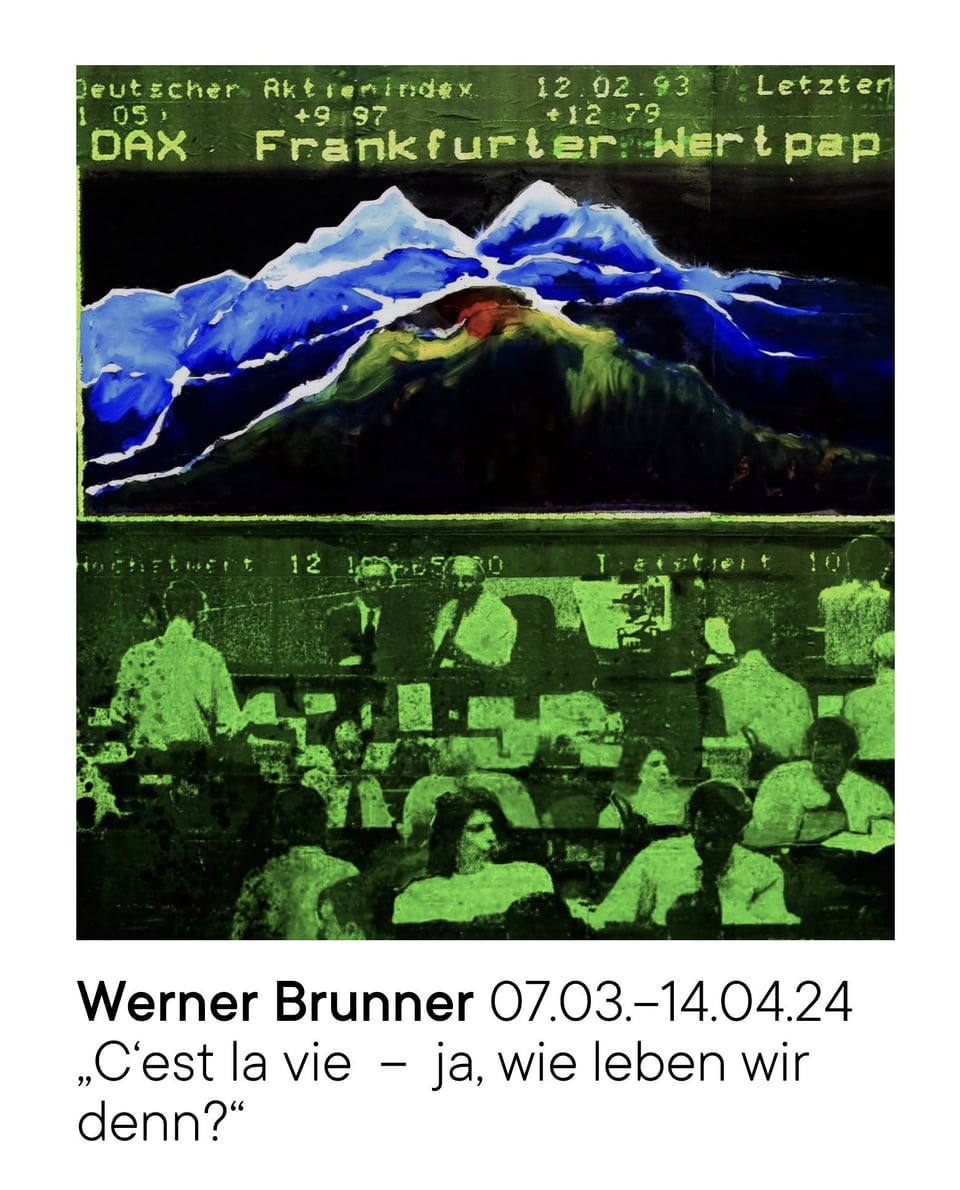
Thematically, his paintings range across architectures and spaces, city and countryside, through “post-war pictures”, animal motifs, the Ark, Atlas, as well as overarching philosophical references such as Nietzsche. Brunner works with montage: newspaper reports, photographs or quotations are incorporated into the pictorial material, painted over or allowed to show through – so that they are not merely decorative accessories but impulses, raw materials for his artistic reflection.
His style is shaped by an interplay: clear thought and formal power, materiality and transparency, narrative and abstraction. Brunner does not simply paint what he sees – he paints what he has already thought. The concept precedes him, and from this inner pre-structure he develops a picture that makes his thoughts visible.
Brunner's work is never trivial or arbitrary: it takes a stance, comes across as critical, ironic or simply lets things show through – and yet is always aesthetically strong. It is art that works on several levels – visually, intellectually and emotionally. For a foundation that owns works by Brunner, these objects hold more than formal expression: one receives documents of an artistic process that incorporates human conditions, historical traces and social spaces – broadly conceived, deeply reflected, visually appealing and intellectually demanding.
Werner Steinbrecher
1946–2008CollectionNo portrait available
Founding member of RATGEB. Born 1946 in Visbek, grew up in Düsseldorf. Studied architecture in Aachen, painting in Nuremberg and Berlin; 1978 master student at HdK Berlin. Moved to Allenbostel near Uelzen in 1989; died 2008 in Bardowick.
Werner Steinbrecher (1946–2008) was a German artist whose work moves between figurative representation and expressive abstraction, and whose public and mural works had an impact far beyond his studio practice. Born in Visbek in Lower Saxony, Steinbrecher grew up in Düsseldorf from 1949. In 1972 he began studying painting at the Academy of Fine Arts in Nuremberg; a year later he transferred to the Hochschule der Künste (HdK) in Berlin. In Berlin he was also a founding member of the artists' group Ratgeb (1977–1986), which became known in particular for its large murals on the facades of Berlin buildings.
Read more
His works are characterised by a tension between the narrative and the symbolic, between figurative motifs – often embedded in expressive gestures – and dense, chromatically powerful composition. Many of his works reveal an interest in the structure of the surface, in the handling of colour and form, in the interplay of inner life and surface, of light and shadow, figure and space. His engagement with public space (mural works) underlines that Steinbrecher understood art not merely as a private pursuit but as a social gesture, a contribution to urban identity and collective perception.
He left behind an oeuvre that works in small formats as well as on large surfaces, realised on paper, on canvas and on walls. Their expressive gesture and strong visual presence mean that his works are today regarded as striking testimonies of a German art after 1945 that builds bridges between personal emphasis and public form.
Biography- 1946 born in Visbek, grew up in Düsseldorf
- 1966 after graduating from high school studied architecture at the TH Aachen
- 1972 after diploma, study of painting with C. Fischer at the Academy of Fine Arts Nuremberg
- 1974 continuation of studies with H. Trökes at the HfbK Berlin
- 1977 foundation of the artist group RATGEB (until 1986)
- 1978 graduation as master student at the HdK Berlin
- 1989 moved from Berlin to Allenbostel (near Uelzen)
- 2008 died on 23 October in Bardowick
Volkmar Förster
* 1939Collection

Telecommunications craftsman, laboratory technician, high-frequency technician, state examination in art education/German, Teacher, theater painter, diploma in stage and costume design, engagements at Schwerin State Theater, stages of Magdeburg city, neues theater Halle, freelance set designer at numerous theaters, set designer for mdr Television, puppeteer, Ultimately a painter and graphic artist.
Volkmar Förster, born 1939 in Chemnitz, is an artist whose long life and diverse professional experience have profoundly shaped his artistic work. His training and professional practice span periods as a telecommunications technician and high-frequency engineer, teaching art education and German, training as a scenic painter and stage and costume designer, and engagements at theatres such as Schwerin, Magdeburg and the “Neues Theater” in Halle (Saale). Förster was also a puppeteer and freelance stage designer, a production designer for film and television, and for many years director of the gallery LandArt in the Vogtland region, where he organised plein-air sessions, symposia and courses in the visual and performing arts. In 2009 he moved to Mecklenburg-Western Pomerania, and in 2014 on to Funkenhagen in the Uckermark.
Read more
Förster's creative work is wide-ranging: he works as a painter and printmaker, is versed in oil and acrylic painting, watercolour, gouache, woodcut and etching, and creates sculptures, installations and performances. His thematic series (“Einsame Räume”, “Huskyträume”, “Der zertanzte Traum”, “Schwanengesang”, “Die Rückkehr des Grüns”, “Die Sagen der Feldberger Seenlandschaft”, among others) are distinguished by particular attention to nature, dream, myth and place, while also leaving room for narrative and stillness, reflection and pictorial space. Förster has also published illustrated books such as “Das Moosmännlein” and “Die Sagen der Feldberger Seenlandschaft”.
For a foundation that owns works by Förster, this means: it holds not merely works in its collection but an oeuvre that has grown over decades, bears the traces of many disciplines – theatre, printmaking, painting – and possesses both a deep local rootedness and a transdisciplinary ambition. His works invite us to think form and content, work and experience, space and narrative together.
Ralf Ehrhardt
* 1950CollectionNo portrait available
Born 1950 in Leipzig, schooling in Hanover. Studied graphic design and photography, then history and art education at FU and HdK Berlin. Co-founder of Galerie 70 in 1976; since 1981 also a freelance artist; since 2010 also resident in Greece.
Ralf Ehrhardt, born in Leipzig in 1950 and raised in Hanover, combines various biographical and cultural influences in his artistic work to form a visual language of his own. His path led him via studies in graphic design and photography at the Fachhochschule Hannover and studies in history and art education at the FU and the HdK Berlin ultimately to art – first as a teacher and co-founder of “Galerie 70”, and from 1981 also as a freelance artist. Since 2010 he has lived and worked part of the time in Greece, which is reflected in his work not only geographically but also in its motifs.
Read more
Ehrhardt's artistic medium is first and foremost collage – complemented by drawing, watercolour and mixed media. His works are shaped by a subtle observation of the world, by an interest in urban structures, cultural codes and social conditions. He brings a fine balance of personal experience, documentary precision and formal clarity to his works. A recurring feature is his gaze on places whose historical or everyday layers he makes visible through materials, found objects or photographic fragments.
With great attention to the relationship between image and context, surface and meaning, Ehrhardt develops groups of works that often arise from travel experiences or everyday observations – and always touch on a larger level: memory, change, cultural identity. As an artist, photographer and teacher, he knows how to mediate between form and content – his work speaks through precision, ironic distance and a quiet poetic tone. It thus fits coherently into the collection of the MTS Foundation, which is dedicated to reflecting on and preserving artistic positions since the 1970s.
Biography- 1950 born in Leipzig, schooling in Hanover
- 1970 studied graphic design and photography at the Fachhochschule Hannover
- 1972 studied history and art education at the FU and HdK Berlin
- 1976 co-founder of Galerie 70 (exhibitions on themes from art, politics, communication and media)
- 1978 master student under Prof. H. Kaufmann
- 1979 grammar school teacher (art and history)
- since 1981 also a freelance artist
- since 2010 also resident in Greece
- Exhibitions (selection): 1994 IKB Industriebank Berlin · 1995 Grundkreditbank Berlin · 1997 Galerie Clasing Münster · 2002 Kunstamt Steglitz-Zehlendorf, Schwartz’sche Villa · 2002 Galerie Laubach Berlin · 2004 Galerie Raum 2 Hamburg · 2005 Tuchmacherhaus Diepholz · 2006 Beverino Diepholz · 2010 Galerie Fukuvama Kleinmachnow · 2011–2020 various group exhibitions in Berlin and Hanover
Paul Blankenburg
† 1996CollectionNo portrait available
Founding member of RATGEB, † 1996. Together with Werner Steinbrecher and Werner Brunner he founded the artists' group Ratgeb in 1977, which created murals in the urban space of West Berlin for eight years.
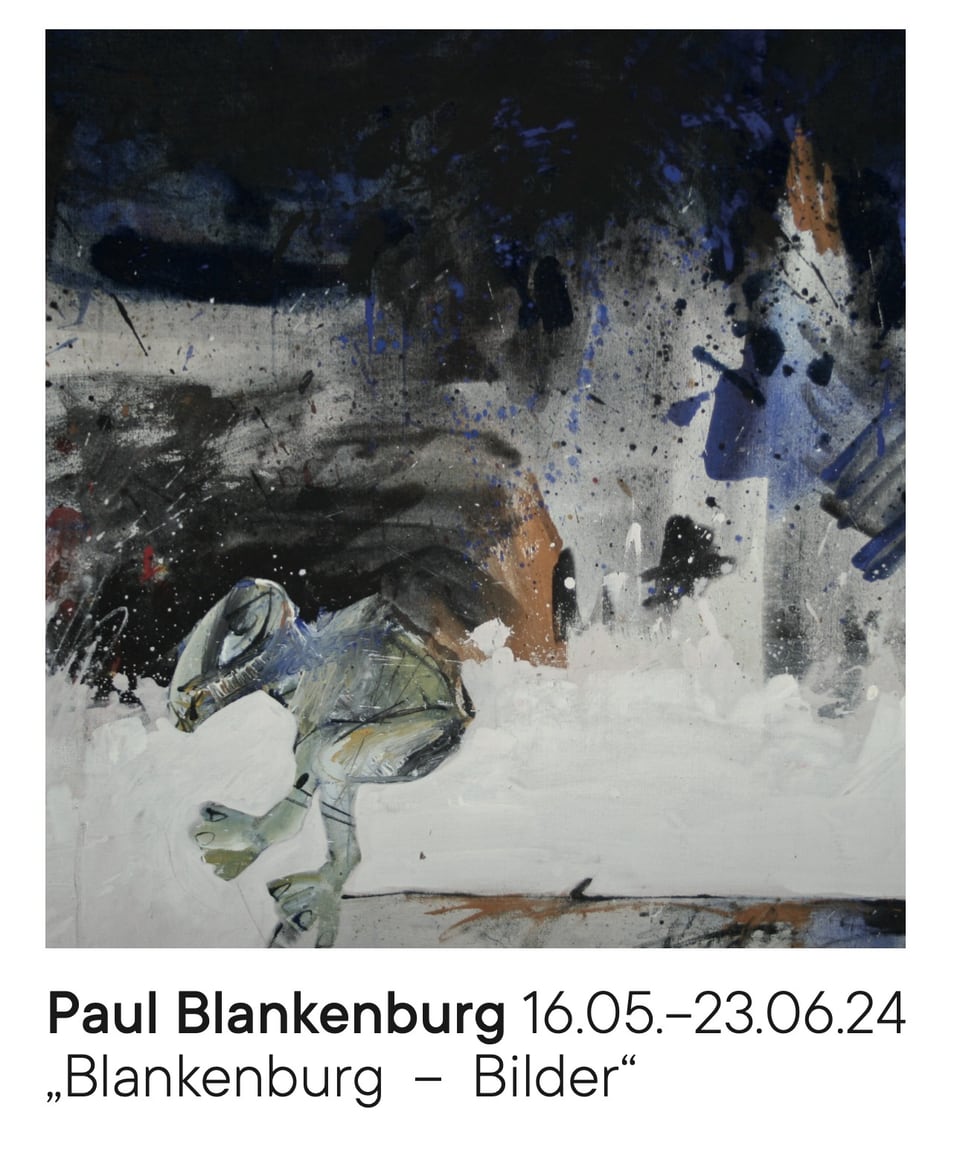
Paul Blankenburg († 1996) was an artist whose work is closely tied to the social discourse and urban reality of his time. Early on he sought exchange, asked questions and deliberately took his art into public space. In 1977 he co-founded the Berlin artists' group RATGEB together with Werner Steinbrecher and Werner Brunner, later joined by Nil Ausländer and Bernd Micka. The group saw itself not only as an artistic collective but also as a social project: for eight years the artists jointly created large-scale murals in the urban space of West Berlin – frequently in cooperation with school classes, young people, squatters or even prisoners. The resulting works carried political, social and historical connotations into public space and were conceived as commentaries on current issues.
Read more
Blankenburg and his colleagues worked with particular technical care: instead of conventional wall paint they used breathable, waterproof mineral paints – so-called secco painting – which permanently silicified with the building fabric. This gave rise to murals such as the one at Pritzwalker Straße 16 or at the Ausbildungswerk Kreuzberg, created together with young people, as well as at a retirement home in Charlottenburg in cooperation with inmates of the Plötzensee juvenile detention centre. Blankenburg was also involved in the design of the interior of the Theater des Westens – a project that attracted attention across Berlin.
His works, including those shown in gallery and exhibition contexts, are characterised by an often sombre, enigmatic visual language. They resist quick legibility, demand engagement and open up spaces for discussion and interpretation. Blankenburg's works stand for an art that does not close off but opens up – to conversations, to positions, to contradiction.
The 13 works are taken from the Foundation's inventory list (oil on canvas, 1980–1992). The attribution of year and dimensions to the individual paintings has not yet been verified.
Dieter Herrmann
* 1949Collection

Born 1949 in Bayreuth. Studied art education at HdK Berlin and political science at FU Berlin; 1980 master student under Johannes Geccelli. Painting and Polaroid montages on the relationship between humans and nature.
Dieter Herrmann, born in Bayreuth in 1949, combines artistic precision with a social stance in his work. He studied art education at the Hochschule der Künste Berlin and political science at the Freie Universität. From 1974 to 1976 he was a member of the NGBK working group “Realismusstudio”. During this period he began to turn away from abstract colour-field painting towards a realistic visual language, prompted by ecological disasters such as the fish kill in the Red Main river or the 1978 oil spill on the coast of Brittany.
Read more
Herrmann's engagement with environmental destruction and the relationship between humans and nature became a central theme of his artistic work. He was also influenced by the working methods of the Spanish artists' group Equipo Crónica, whose montage-based painting he translated into his own visual language. In 1980 he became a master student under Prof. Johannes Geccelli at HdK Berlin.
Alongside his artistic work, Herrmann was involved in social and cultural-education projects with young people and worked in the field of visual media and addiction prevention. In the late 1980s he developed an independent technique of multiple exposure with Polaroid film. These photographic montages, for example of buildings from the Internationale Bauausstellung (IBA) Berlin, attracted international attention and were included in the Polaroid Collection in Cambridge, Massachusetts.
Herrmann's work addresses the fragile relationship between humans, society and nature. His pictures call for reflection – not loudly, but with quiet insistence. Whether in painting or photography, his works show the vulnerable individual within the tensions of social reality. For him, art becomes a place of dialogue: between form and responsibility, between personal feeling and public awareness.
„Art has a humane purpose. It is not enough to merely show the problems and contradictions of society, but rather to depict the life of the individual human being as someone who communicates with others in society, has fears and worries, loves, suffers, and fights for a life of dignity. The human being is a valuable individual.“
Credo 1974
Michael Thomas Schröder
* 1949Collection

Michael Thomas Schröder, born 1949 in Berlin, founded the Galerie 70 in Berlin-Charlottenburg, Schillerstrasse 70, together with friends in 1977, which in turn was the center of Berlin’s political cultural scene until its closure in 1986.
In addition to political-documentary exhibitions on topics such as “Brokdorf”, “§ 218”, “Kunst gegen Rechts”, “SPIEGEL-Titelseiten”, “Kriegsspielzeug”, “Kein schöner Land”, there were various joint political art projects with the artist group RATGEB, such as “Fussball & Folter” (Football & Torture) on the occasion of the World Cup in Argentina in 1978. In 1982, Fotogalerie 70 was opened on the 2nd floor of Galerie 70 with exhibitions by Andrew Savulich/NY, Stanislav Tuma/Prague or F.C.Gundlach/HH.
Read more
He then curated exhibitions for the Berlin art associations NGBK and NBK, such as “1984” in the provisional Kunsthalle Hallensee and “Art in Exile” in the Orangerie Schloss Charlottenburg.
Many contacts and close friendships with visual artists nationally and internationally stem from these years, which in turn was the basis and motivation for the establishment of the foundation.
- 2009 · Kunsthof Dahrenstedt
- 1984 · “Adieu ’84 – Variierte Phantasmen”, group exhibition of the Neue Gesellschaft für Bildende Kunst (nGbK) at the Deplanakunsthalle
Painter, sculptor and draughtswoman, born 1972 in Erbach im Odenwald, lives and works in Berlin. Master student at UdK Berlin. Rhythm and movement as themes in sculpture, drawing and live painting.
Ilona Ottenbreit is a German painter, sculptor and draughtswoman. She was born in Erbach im Odenwald in 1972, grew up in Karlsruhe and today lives and works in Berlin. Ottenbreit studied painting under Professor Volker Stelzmann at UdK Berlin and in 2002 switched to sculpture under Professor Harro Jacob. She completed her studies in 2005 and became a master student at UdK Berlin in 2006.
Read more
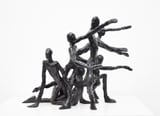
In her artistic work, Ilona Ottenbreit explores rhythm and movement, which she understands as the “cause of our life”. Her sculptures show groups of people in motion, representing a collective connection or unity. A central starting point of her work is drawing sequences of movement. She follows dancers with a line and records what she can grasp intuitively. The resulting abstract figure drawings are further worked with charcoal and ink.
In 2011 Ilona Ottenbreit founded the performance group Dimensionen, which combines dance, theatre, music and painting. In 2020 the artists' collective Heads & Voices was formed, working with spoken word, live painting as well as experimental music and electronic sounds. Live paintings and performances define her artistic work and mean that her exhibitions are in a state of continual change, which viewers can also experience.
Ilona Ottenbreit has exhibited in solo and group exhibitions in Germany and the United Kingdom. Her works are held in public collections in Berlin and Karlsruhe, among others.
-
Werner Brunner Prometheus 1987 acrylic & paper on cotton 120 × 145 cm -
Werner Steinbrecher Auf nach… „Brokdorf“! 17.02.1977 50,5 × 36,5 cm -
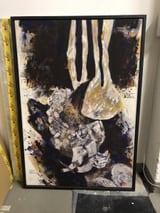
Volkmar Förster Die Trennung 2012 gouache, oil pastel on canvas 140 × 120 cm -
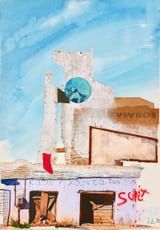
Ralf Ehrhardt verkuppelt 2004 watercolour, collage, drawing 70 × 100 cm -
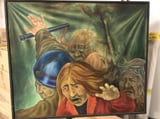
Paul Blankenburg Ohne Titel oil on canvas -
Dieter Herrmann Unknown -
Michael Thomas Schröder Ohne Titel -
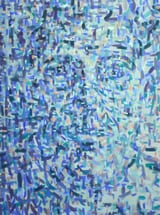
Ilona Ottenbreit Dissolved head 2025 140 × 160 cm -
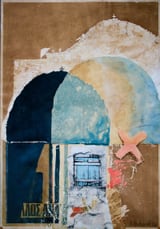
Werner Brunner I Love you, I eat you 2009/2018 oil, acrylic, paper on cotton 180 × 180 cm -
Werner Steinbrecher Frauenemanzipation 1977 49,5 × 35 cm -
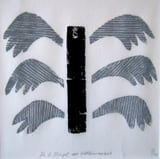
Volkmar Förster Die 6 Flügel der Vollkommenheit 2006 material print 25 × 25 cm -
Ralf Ehrhardt still laughing… 2023 watercolour, collage, drawing, oil frottage 100 × 140 cm -
Paul Blankenburg Ohne Titel oil on canvas -
Dieter Herrmann Unknown 2 -
Michael Thomas Schröder Ohne Titel -
Ilona Ottenbreit The movement of a dance 2026 charcoal, acrylic 160 × 180 cm -
Werner Brunner Trümmerfrauen 1980 acrylic on cotton; painted wooden frame 110 × 150 cm -
Werner Steinbrecher Handzeichen 1977 print, unframed 31 × 44,5 cm -
Volkmar Förster Frühlingsmond 2013 acrylic on canvas 90 × 150 cm -
Ralf Ehrhardt GIGAS. 2006 watercolour, collage, drawing, oil frottage 50 × 70 cm -
Paul Blankenburg Ohne Titel oil on canvas -
Michael Thomas Schröder Ohne Titel -
Ilona Ottenbreit Head A. G. 2022 160 × 120 cm -
Werner Brunner Selbstportrait 12 1981 acrylic on cotton; painted wooden frame 111 × 111 cm -
Werner Steinbrecher Ira 1977 print, unframed 40 × 54 cm -
Volkmar Förster Frühlingsmond oben 2013 acrylic on canvas 90 × 45 cm -
Ralf Ehrhardt funny facade III 2009 watercolour, collage, drawing, oil frottage 70 × 100 cm -
Paul Blankenburg Ohne Titel oil on canvas -
Michael Thomas Schröder Verkalkt -
Ilona Ottenbreit Head L. 2025 180 × 150 cm -
Werner Brunner Griechenland II Aigina Hausbau 1981 bis 1983 acrylic on cotton; white wooden frame 110 × 110 cm -
Werner Steinbrecher Die lezten Tage 4 Notarzt 1981 35 × 48 cm -
Volkmar Förster Frühlingsmond unten 2013 acrylic on canvas 90 × 45 cm -
Ralf Ehrhardt Blaue Stunde 2017 watercolour, collage, drawing 40 × 50 cm -
Paul Blankenburg Ohne Titel oil on canvas -
Michael Thomas Schröder Kalte Dusche -
Ilona Ottenbreit Head „JM“ 2022 210 × 180 cm -
Werner Brunner Grüner Blutmann 1983 acrylic on cotton 113 × 145 cm -
Werner Steinbrecher Männer statt man 1981 60 × 39,5 cm -
Volkmar Förster Königin der Nacht 2013 acrylic on canvas 110 × 130 cm -
Ralf Ehrhardt Junta. 2017 watercolour, collage, drawing 40 × 50 cm -
Paul Blankenburg Ohne Titel oil on canvas -
Michael Thomas Schröder Ohne Titel -
Ilona Ottenbreit Head dissolved blue-green 2023 -
Werner Brunner 150 Jahre Sanitaerhygiene sind genug 1985 acrylic & paper on cotton 100 × 145 cm -
Werner Steinbrecher Liegestellung/Liegestütz 1992 print, unframed 38 × 53 cm -
Volkmar Förster Sagenreiche Entwurfszeichnung 2013 31 × 43 cm -
Paul Blankenburg Ohne Titel oil on canvas -
Michael Thomas Schröder Ohne Titel -
Ilona Ottenbreit Who am I — head blue-red 2026 180 × 150 cm -
Werner Brunner Mauerbau aus der Ferne TV gesehen 1987 acrylic, paper & cardboard on cotton 183 × 120 cm -
Werner Steinbrecher Ohne Titel 1992 print, unframed 39 × 53 cm -
Volkmar Förster Schöneck, Forststraße 2013 reed pen, ink 50 × 70 cm -
Paul Blankenburg Ohne Titel oil on canvas -
Ilona Ottenbreit Tanz IV 2012 44 × 64 cm -
Werner Brunner Treibhaus 1988 bis 2004 acrylic on cotton; black wooden frame 185 × 125 cm -
Werner Steinbrecher Sonnenschaukel 3 1992 print, unframed 28 × 42 cm -
Volkmar Förster Schöneck, Klingerstraße 2013 reed pen, ink, acrylic 70 × 90 cm -
Paul Blankenburg Ohne Titel oil on canvas -
Ilona Ottenbreit Livepainting aus der Serie BE MOVE -
Werner Brunner Zu treuen Händen 1991 acrylic & sand on paper on cotton 111 × 157 cm -
Werner Steinbrecher Ohne Titel 2002 31 × 27 cm -
Volkmar Förster Schöneck, Mangelsdorfer Straße 2013 reed pen, ink 50 × 70 cm -
Paul Blankenburg Ohne Titel oil on canvas -
Ilona Ottenbreit Livepainting „Tanz mit Abel“ 2022 150 × 180 cm -
Werner Brunner Explosiv I 1992 mixed media 150 × 120 cm -
Werner Steinbrecher Ohne Titel 2002 40 × 30 cm -
Volkmar Förster Streugrün I 2013 reed pen, ink 75 × 37 cm -
Paul Blankenburg Ohne Titel oil on canvas -
Ilona Ottenbreit Figurengruppe I bronze -
Werner Brunner Explosiv II 1992 mixed media 150 × 120 cm -
Werner Steinbrecher Ohne Titel chipboard, unframed 40 × 60 cm -
Volkmar Förster Streugrün II 2013 reed pen, ink 70 × 45 cm -
Paul Blankenburg Ohne Titel oil on canvas -
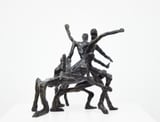
Ilona Ottenbreit Figurengruppe II (Ansicht 1) bronze -
Werner Brunner Gute Nacht Leipziger Platz 1996 oil pastel, acrylic & paper on plywood 150 × 150 cm -
Volkmar Förster Vorwärts 2012 gouache on canvas 130 × 110 cm -
Paul Blankenburg Ohne Titel oil on canvas -
Ilona Ottenbreit Figurengruppe II (Ansicht 2) bronze -
Werner Brunner Erschrecken der Loreley 1998 acrylic & sand on cotton 106 × 123 cm -
Volkmar Förster Streugrün III 2013 reed pen, ink 76 × 37 cm -
Ilona Ottenbreit Figurengruppe II (Ansicht 3) bronze -
Werner Brunner Stroh 1998 oil, acrylic on cotton 180 × 210 cm -
Volkmar Förster Wohlbach 2013 reed pen, ink 30 × 30 cm -
Ilona Ottenbreit Skulpturengruppe I (Ansicht 1) bronze -
Werner Brunner An der Elbe 2002 acrylic on cotton; painted wooden frame 110 × 150 cm -
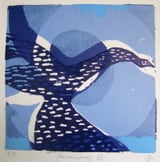
Volkmar Förster Schwanengesang 8 2014 colour woodcut 22 × 21 cm -
Ilona Ottenbreit Skulpturengruppe I (Ansicht 2) bronze -
Werner Brunner Elbe bei Dessau 2002 acrylic on cotton in painted wooden frame 110 × 150 cm -
Volkmar Förster Die Erscheinung 2015 acrylic 21 × 30 cm -
Ilona Ottenbreit Skulpturengruppe I (Ansicht 3) bronze -
Werner Brunner Versatzstücke 2002C acrylic, sand & paper on cotton 150 × 150 cm -
Volkmar Förster Die Rückkehr 2015 oil on canvas 90 × 120 cm -
Werner Brunner Statistics Mountains IV 2004 oil, acrylic, paper on cotton 180 × 200 cm -
Volkmar Förster Grün XII 2015 roller print, collage 30 × 31 cm -
Werner Brunner Das Souvenir 10 2006 acrylic & paper on cotton 150 × 150 cm -
Volkmar Förster Selbst vor vulkanischer Landschaft, Zustandsdruck 1,2 und 3 2015 colour woodcut 36 × 41 cm -
Werner Brunner Götzen-Dämmerung II 1995 acrylic on cotton 210 × 150 cm -
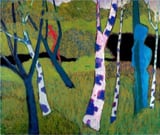
Volkmar Förster Birkenreihe 2016 overpainted photo canvas 110 × 180 cm -
Volkmar Förster Der Schornstein 2016 acrylic 21 × 30 cm -
Volkmar Förster Die Pause 2016 overpainting 28 × 42 cm -
Volkmar Förster Vom Seeadler zum Moorfrosch 2016 room installation, floor panel 130 × 130 cm -
Volkmar Förster Grün IVX 2016 stencil technique 20 × 42 cm -
Volkmar Förster Grün IX 2016 roller print, felt-tip pen, collage 29 × 36 cm -
Volkmar Förster Grün XI 2016 felt-tip pen, collage 30 × 36 cm -
Volkmar Förster Grün XI 2016 cardboard print, collage 25 × 33 cm -
Volkmar Förster Grün XV 2016 roller print, felt-tip pen, collage -
Volkmar Förster Grün XVI 2016 cardboard print, felt-tip pen, collage -
Volkmar Förster Grün XVII 2016 cardboard print, felt-tip pen, collage -
Volkmar Förster Grün XX 2016 roller print, felt-tip pen, spray technique 60 × 70 cm -
Volkmar Förster Zuneigung I 2016 colour etching, hand-coloured, collage 20 × 28 cm -
Volkmar Förster Gier III 2.6 2020 colour woodcut 28 × 28 cm
Events
-
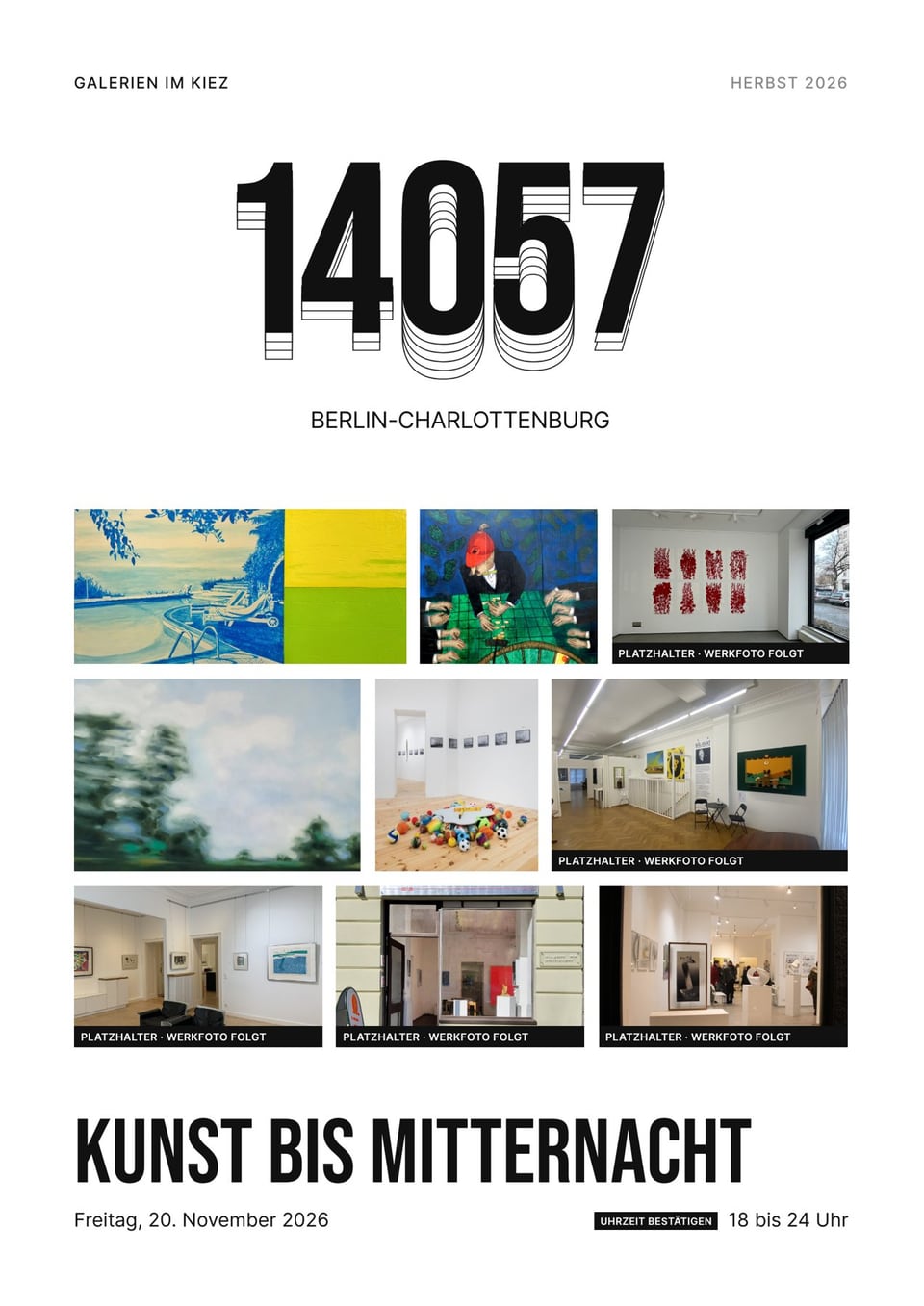
- Dates
- 20 Nov 2026
- Opening
- Opening with a book signing of “Der Philosoph”
- Opening hours
- 6 pm to midnight
- Venue
- GALERIE 15, Kuno-Fischer-Straße 15/Suarezstrasse 31, 14057 Berlin
- Series
- Event
- Artists
- Volkmar Förster
“14057 Berlin-Charlottenburg” is the association of galleries, project spaces and studios in the neighbourhood between Lietzensee and Amtsgerichtsplatz. Each venue has its own programme and its own signature. What they share is the postcode and the wish to make art in the neighbourhood more visible.
Kunst bis Mitternacht is the evening they host together: on Friday, 20 November 2026, every door is open from 6 pm to midnight – with painting, prints, sculpture, sound, readings and music, on foot from door to door. The walk starts at the meeting point, ParkSide Gallery on Dernburgstraße.
At GALERIE 15, “Der Philosoph” by Volkmar Förster is on view that evening, with a signing session for the book of the same name.
-
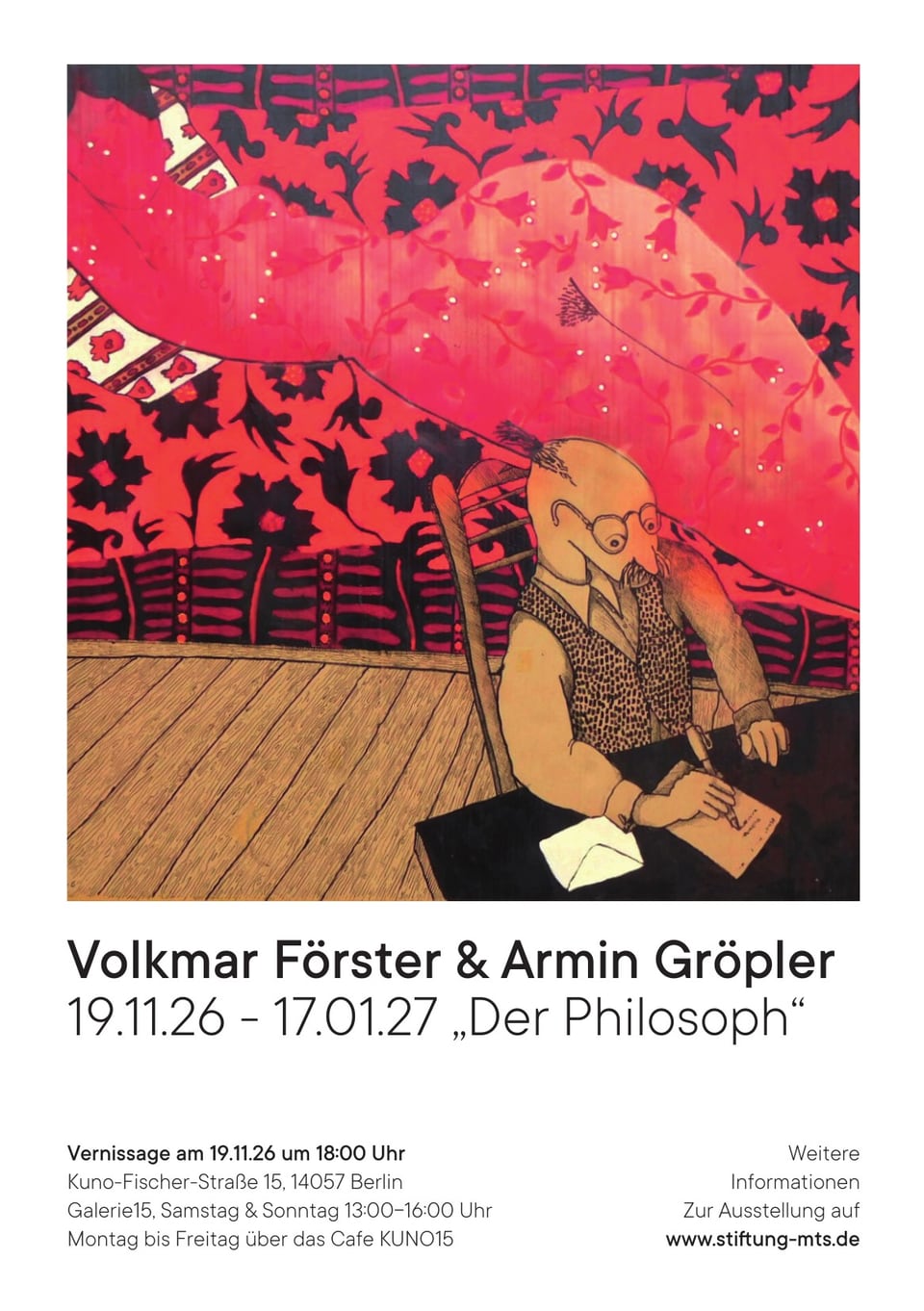
- Dates
- 19 Nov 2026 – 17 Jan 2027
- Opening
- 19 November 2026, 6 pm
- Venue
- GALERIE 15, Kuno-Fischer-Straße 15/Suarezstrasse 31, 14057 Berlin
- Series
- From the collection
- Artists
- Volkmar Förster, Armin Gröpler
At the centre of the exhibition “Der Philosoph” are the original works by Volkmar Förster: 28 drawings and ten colour acrylic works, created as independent pictorial responses to 38 rhymed texts by Armin Gröpler. Förster's pictures narrate, condense and transform the literary motifs and open up spaces, figures and situations of their own – by turns comic, abysmal, quiet and thoughtful.
Armin Gröpler's texts are the starting point and the counterpart of the pictures. In six rhymed lines each, Gröpler sketches the ironic, bizarre, fictional biography of an intellectual who wrestles with the great questions of life as much as with his everyday adversities – pointed, with dry humour, down to the laconic final verdict: “Sein Leben war durchaus verpatzt.”
Förster does not illustrate these verses in the conventional sense. His works stand opposite the texts as an independent artistic position. Words become pictures, punchlines become scenes, thoughts give rise to new associations.
In the book of the same name, “Der Philosoph”, image and text finally meet as equals. The exhibition deliberately reverses this dialogue: it first gives the original pictures the space and lets the texts resonate alongside. This makes visible how a pictorial world grows out of a literary idea – and how the two come together again as a whole in the book.
-
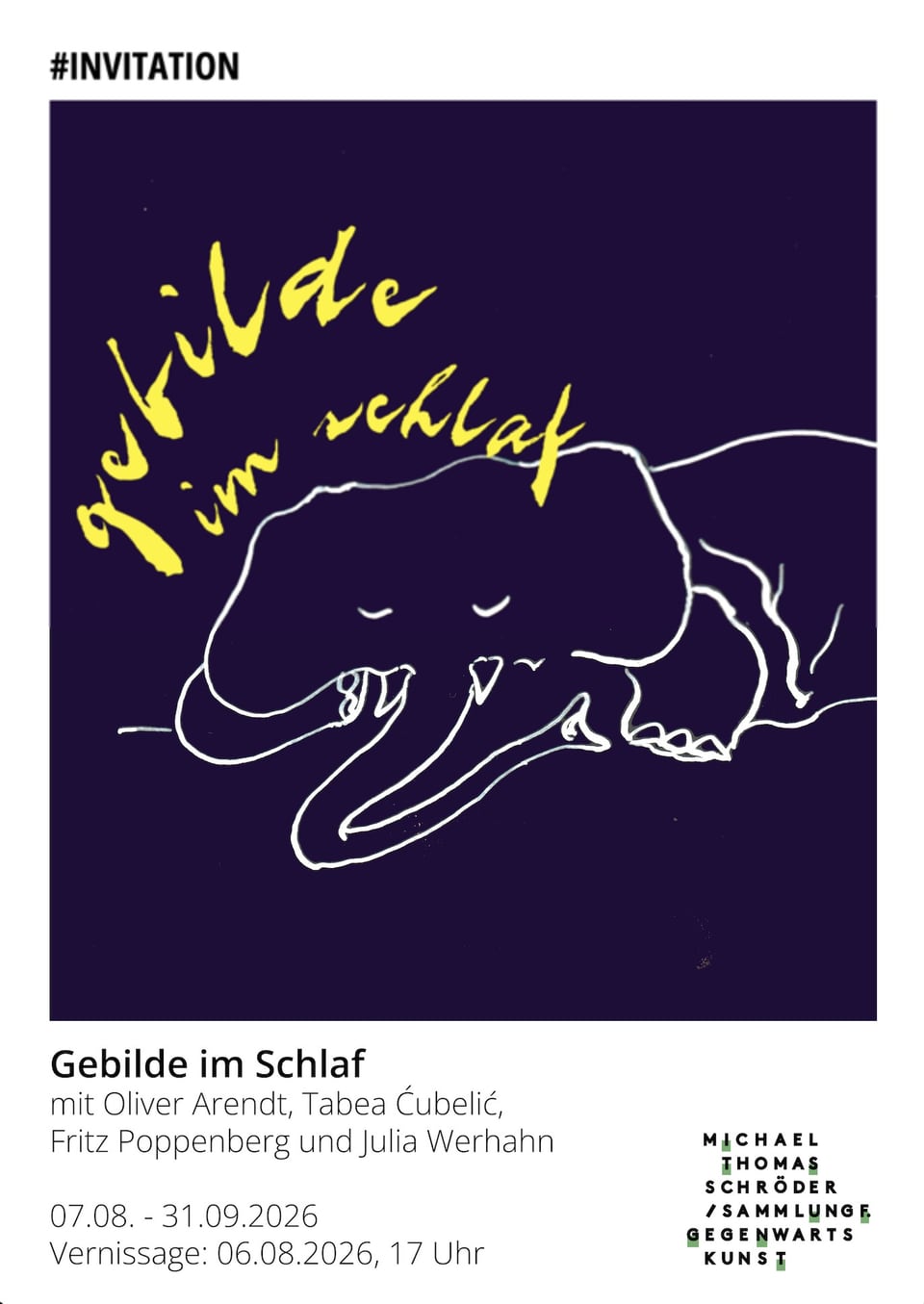
- Dates
- 7 Aug – 30 Sep 2026
- Opening
- 6 August 2026, 5 pm
- Venue
- GALERIE 15, Kuno-Fischer-Straße 15/Suarezstrasse 31, 14057 Berlin
- Series
- INVITATION series
- Artists
- Oliver Arendt, Tabea Ćubelić, Fritz Poppenberg, Julia Werhahn
“Mathematically speaking, one could say that the capacity for unriddling is the inverse function of dreaming. By day it unpacks what was condensed in sleep and shifts it with the sign reversed. Yet unlike a mathematical inverse function, the capacity for unriddling is not unambiguous. It remains in the realm of supposing, trying and groping. And what emerges from it becomes part of the day's experience and can thus be re-riddled in the next sleep together with other parts of memory.” (From the exhibition text by Oliver Arendt.)
Four younger artists from Berlin whose work revolves around the night side of life while also leaving room for daydreams. Artworks for musing, reflecting and dreaming on.
Oliver Arendt draws, writes, collects, sorts, builds and programs. This gives rise to artefacts with a life of their own, which usually have a mathematical and technical origin but also take on creaturely traits. They form the mental space that is traversed entirely subjectively in the artistic work.
Tabea Ćubelić investigates dreams, memories and the riddles of origin. Her drawings and objects both reflect and embody the mental and material finds she makes in the process.
Fritz Poppenberg paints and draws. In doing so he is committed to the history of painting and, in this exhibition, also to that of the classic comic. His work negotiates the time from childhood and youth to adulthood; the Romantic concept of art and its conventions; and the melancholy of a time already lost to us.
Julia Werhahn is concerned with collective fears and longings. In her work she explores the fragility of inner structures that carry within them the sense of a crumbling existence. Transparent reliefs and sculptures, into which complex feelings such as trust, scepticism or an all-encompassing powerlessness are worked, form the focus of her work.
Part of the Invitation series of the Michael Thomas Schröder Foundation at Galerie 15.
-
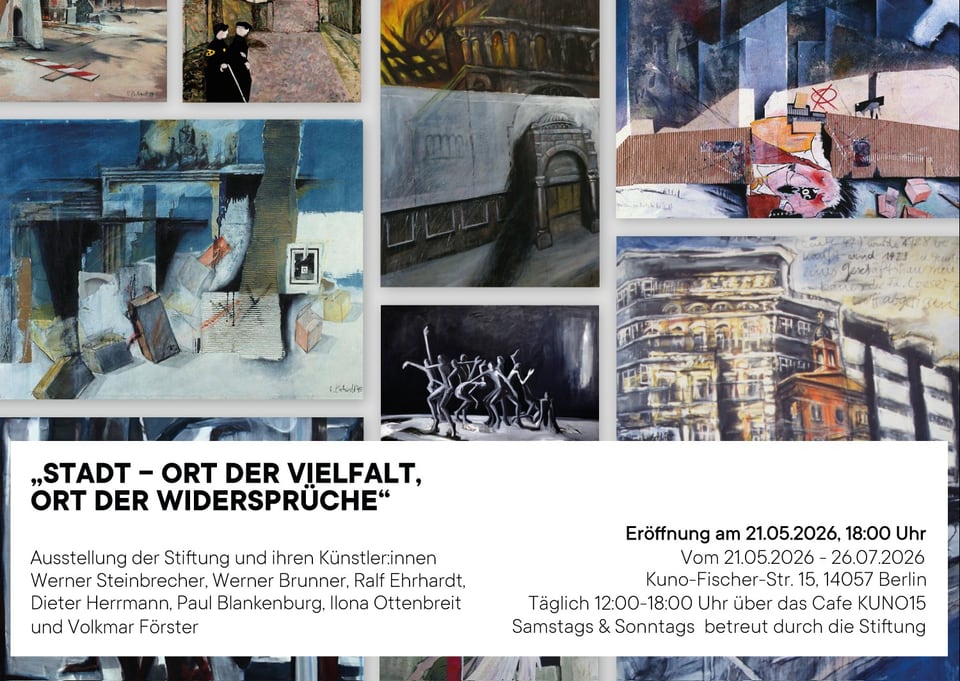
- Dates
- 21 May – 26 Jul 2026
- Opening
- 21 May 2026, 6 pm
- Opening hours
- Daily 12–6 pm via Café KUNO15; on Saturdays and Sundays staffed by the Foundation
- Venue
- GALERIE 15, Kuno-Fischer-Straße 15/Suarezstrasse 31, 14057 Berlin
- Series
- From the collection
The city is not an unambiguous place. It is promise and imposition, encounter and isolation, order and rupture all at once. For decades artists have engaged with this field of tension – not in order to resolve it, but to make its contradictions visible.
The positions gathered in this exhibition likewise present no uniform view of the urban. Rather, they unfold different, at times contrary perspectives: the city appears as structured space and as fragile fabric, as a place of collective experience and individual lostness, as an engine of change and as a stage of standstill.
It is precisely in this ambiguity that its artistic power lies. The city eludes simple interpretations – and constantly calls for new images, new approaches, new questions.
The exhibition sees itself as an open field for this engagement. It invites us not to pin the city down, but to see it anew in its complexity and contradictoriness.
-
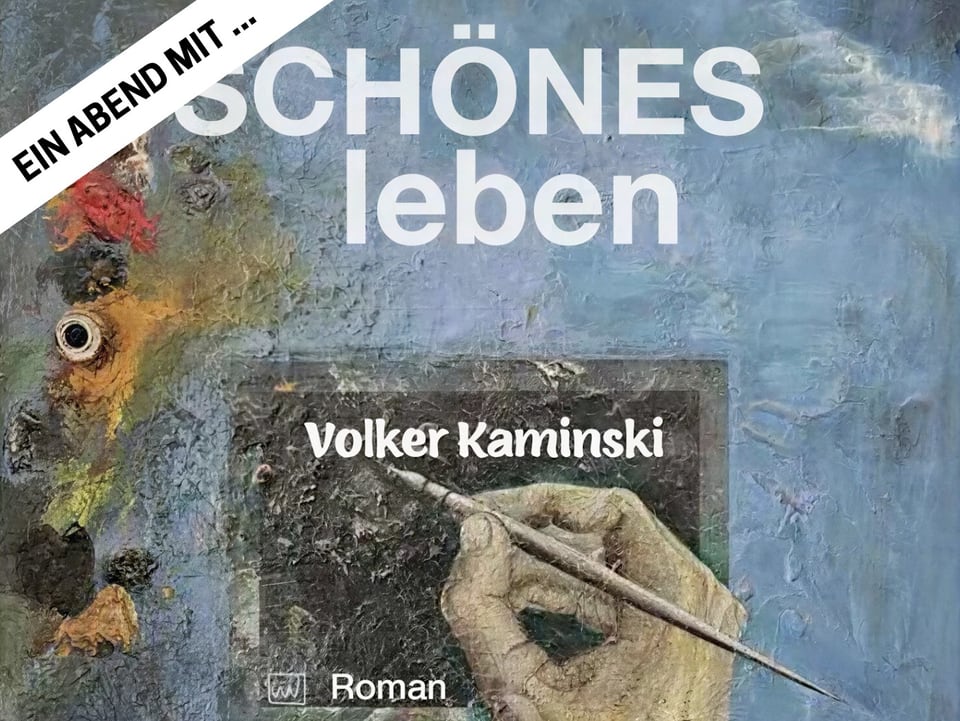
- Dates
- 26 Mar 2026
- Opening
- Reading, Thu, 26 March 2026, 7:30 pm
- Venue
- GALERIE 15, Kuno-Fischer-Straße 15/Suarezstrasse 31, 14057 Berlin
- Series
- Event
- Artists
- Volker Kaminski, Karl Wunsch
VOLKER KAMINSKI, born in Karlsruhe, studied German literature and philosophy in Freiburg and Berlin, where he lives as a freelance writer. In addition to short stories, columns (Berliner Zeitung) and reviews, he has published numerous novels (e.g. “Rot wie Schnee”, “Auf Probe”, “Der Gestrandete”). PalmArtPress has so far published “Herzhand” (2021), “RUA 17” (2023) and “Die letzte Prüfung” (2024, revised new edition). Since 2014 he has been a lecturer at the Alice Salomon Hochschule in Berlin, where he teaches on a master's programme in Creative Writing. He has received several grants, including the Alfred Döblin Fellowship, the grant of the Kunststiftung Baden-Württemberg and the Künstlerhaus Edenkoben residency grant.
At Galerie15, the Berlin author reads from his new novel “SCHÖNES leben”, accompanied by Karl Wunsch on saxophone.
About the novel:
Sixteen-year-old Viktor does not have it easy. To escape his parents' fierce quarrels, he creates a world of beauty of his own and develops a passion for painting. After his mother and sisters move out, he is left behind with his father, who numbs the pain of the shattered dream of a large family with alcohol. Viktor is accepted at the art academy but has to defend himself against the attacks of his father, who rejects Viktor's career choice. In the struggle for recognition, wavering between understanding and hatred, Viktor develops into a headstrong painter, supported by his professor and the life model Irm. The pub conversations of the art students reflect the zeitgeist of the 1980s.
www.volkerkaminski.wordpress.com
-
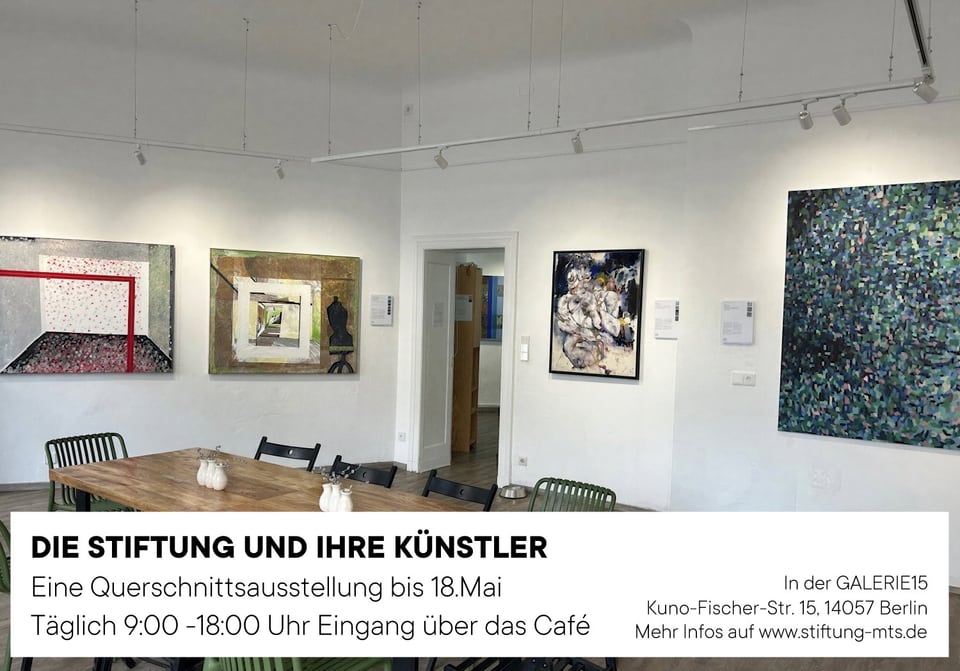
- Dates
- until 17 May 2026
- Opening hours
- Daily 9 am–6 pm, entrance via Café KUNO15
- Venue
- GALERIE 15, Kuno-Fischer-Straße 15/Suarezstrasse 31, 14057 Berlin
- Series
- From the collection
A cross-section exhibition of the collection with works by nine of the Foundation's artists, shown at GALERIE15 until 17 May 2026.
-
- Dates
- Dates to be confirmed
- Venue
- GALERIE 15, Kuno-Fischer-Straße 15/Suarezstrasse 31, 14057 Berlin
- Series
- INVITATION series
- Artists
- Anne Dérian
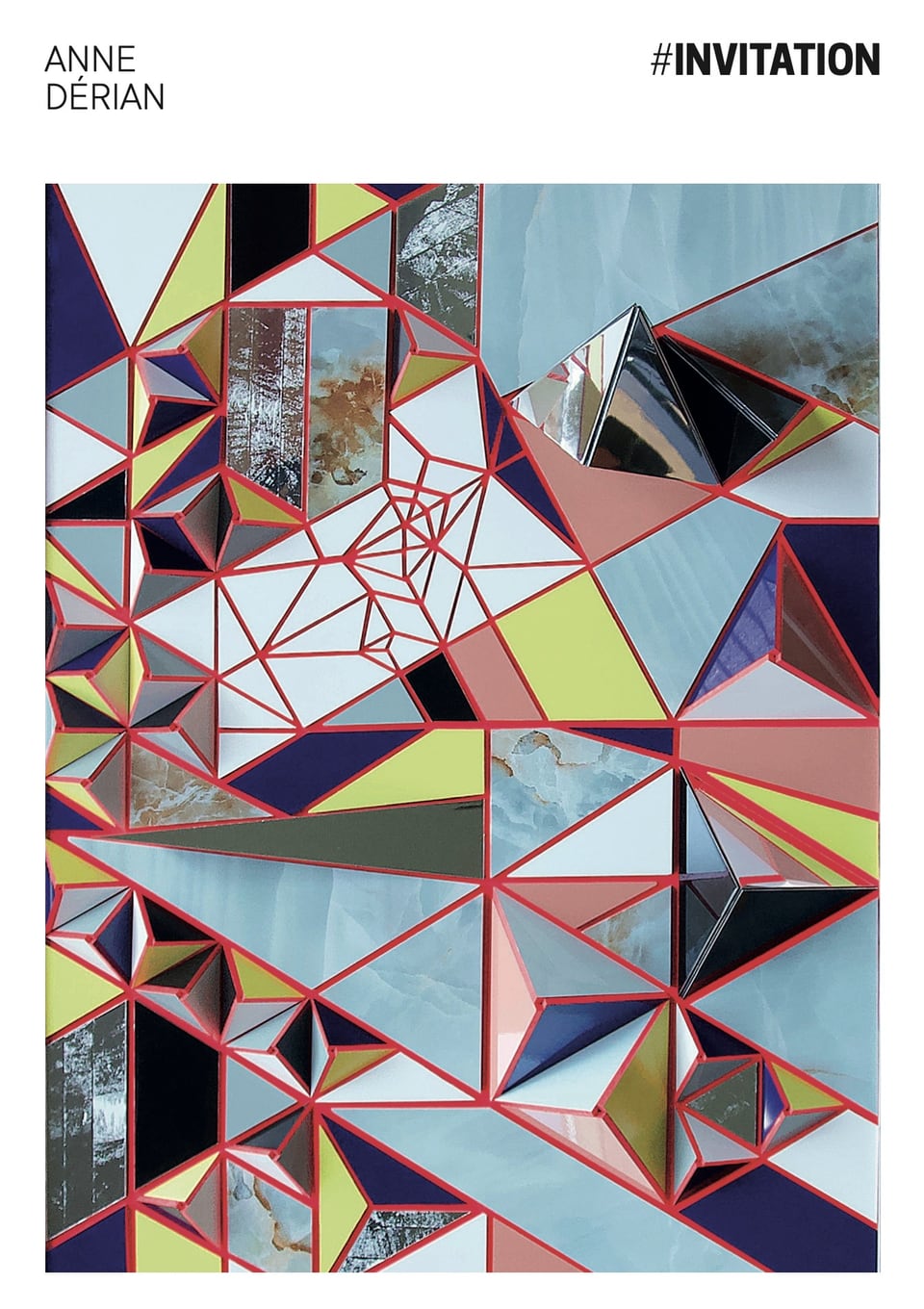
In her solo exhibition “Inmost / Almost”, the Berlin-based French artist Anne Dérian presents two contrasting sides of her artistic work. Both gallery rooms are used to make different approaches to material, form and process tangible.
The first room, “Inmost”, invites quiet contemplation. In a meditative atmosphere, works emerge that – inspired by mandalas – lead to inner reflection and contemplative perception. Here the focus is on a sensory experience of art beyond language. “Almost”, in the second room, shows an energetic, fragmented aesthetic. The title is a playful allusion to the phrase “Almost finished” and refers to the artist's precise but time-intensive approach. The focus here is on the dissection of surfaces, materiality and colour-induced emotions. During the exhibition, Anne Dérian will also use the space as a studio – the creative process thus becomes part of the exhibition and can be experienced live by visitors.
Anne Dérian lives and works in Berlin. After several years as an architect she turned to the visual arts. Her works – from drawings to sculptural objects – combine her architectural background with a deeply personal, intuitive approach. Geometry, modular structures, the play of light and shadow, and a sensitive feel for colour and material characterise her works.
-
- Dates
- 11 Sep – 31 Oct 2025
- Venue
- GALERIE 15, Kuno-Fischer-Straße 15/Suarezstrasse 31, 14057 Berlin
- Series
- From the collection
- Artists
- Volkmar Förster
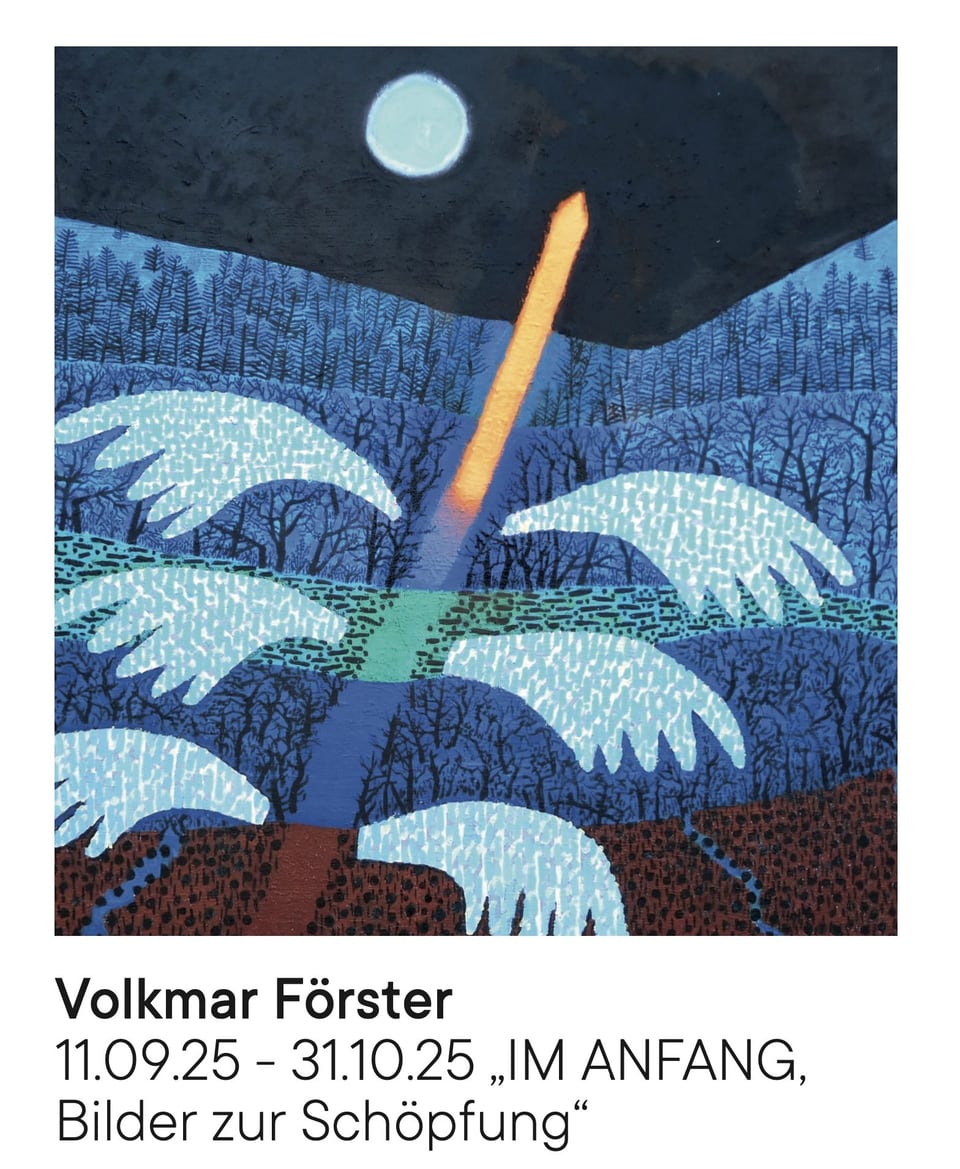
Volkmar Förster with some thoughts on the exhibition
Why does an atheist paint pictures on the Bible?
Not baptised, not confirmed, socialised in the former GDR – I had few points of contact with Christianity. The decision at the age of fourteen between Jugendweihe and confirmation, a problem that many of my friends' parents faced, did not arise for me. Only late, during my studies, did I read Thomas Mann's magnificent novel cycle “Joseph und seine Brüder”; that reading still resonates with me today. It was my very first encounter with Christian mythology at all. In my stage-design diploma project “Urfaust” the “Gretchen question” is posed: “Now tell me, how do you stand with religion? I believe you are a thoroughly good man, only I think you do not hold much of it.”
Faith plays a quite essential role among ordinary people; it is the cornerstone of ethical and moral conduct as a whole. Karl Marx wrote in 1848: “Religion is the opium of the people.” Lenin turned this into: “Religion is opium for the people.” This religion-critical attitude shaped the educational policy of the GDR. The Church with its two confessions did exist, though tolerated rather than welcomed. It was a marginal phenomenon of social life.
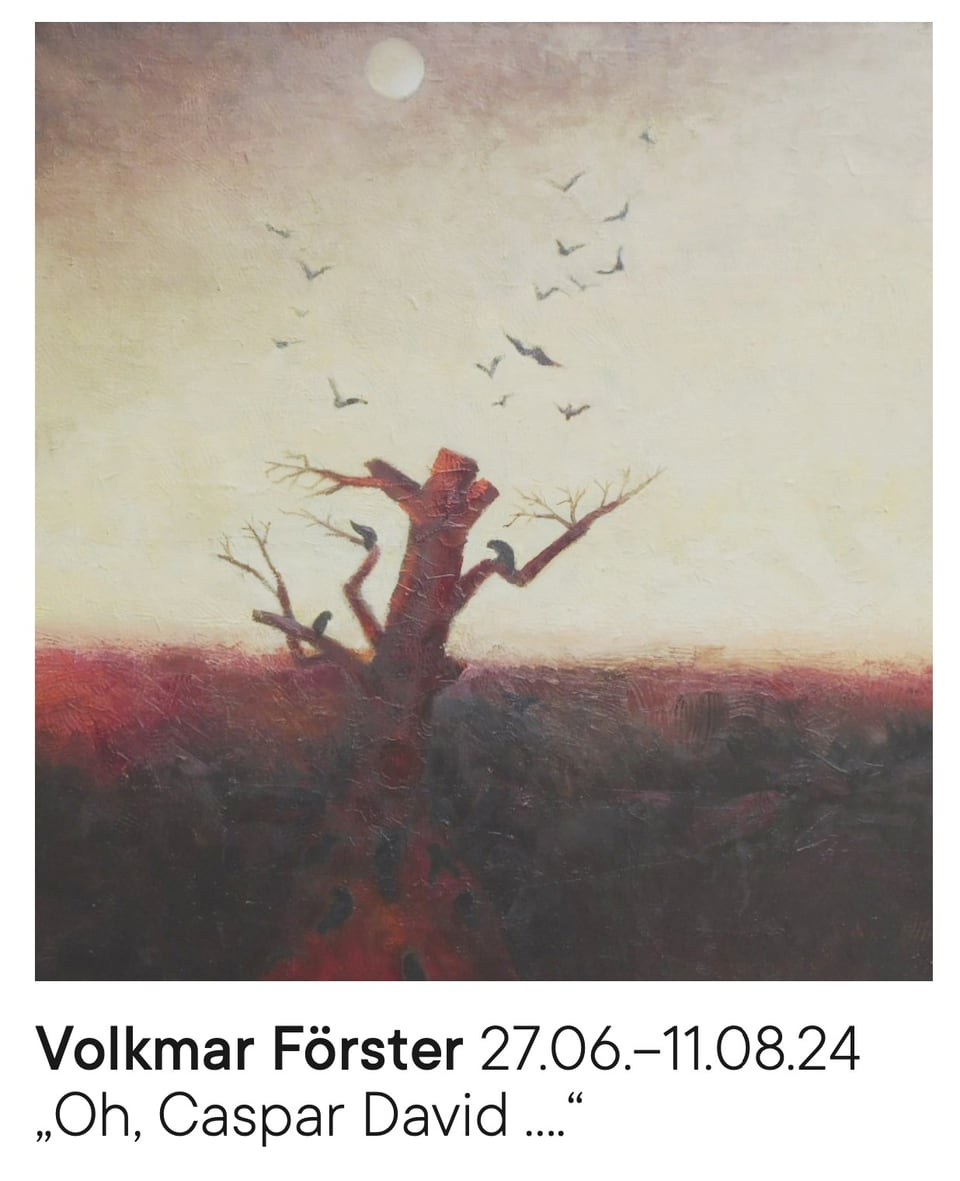
If I were to describe my development as a visual artist, I began as a landscape painter. Working directly in front of nature, sitting before the motif, a feeling very often arose, an awe at the magnificence of creation. Pantheism, also in Goethe's sense, is very close to me. “God is nature”, as a religious feeling of admiration. After engaging with the human figure – life drawing is the prerequisite – I ventured into mythological themes. In 2000 “Ikarus” at the Kunstwandelhalle Bad Elster, followed by many works, performances and exhibitions on the Nibelungen saga.
The garden, the miniature format of nature so to speak, has always been the focus of my efforts.
Most of my great colleagues painted their gardens at the end of their lives. So did I. In 2002 I portrayed our garden around the house. Twelve small-format oil paintings, drawings, and colour and black-and-white woodcuts emerged. From this developed the idea of populating our garden with Adam and Eve. Consequently I came upon the Old Testament. For the first time I read the original texts of Genesis, which fascinated me immediately. There is no more beautiful sentence than: “Let there be light”
The first picture with this title was followed by 19 more in a dramaturgical sequence: the creation of the world, the fall of man, and ending with the birth and crucifixion of Christ, that is, with the New Testament. Countless visual artists, from the past to the present day, have created magnificent works of art on these themes. A great challenge for me in any case.
During the work, questions arose about the meaningfulness of the project. What significance did the Christian myth have for the development of humanity? Are the teachings of Christ still relevant to our present?
The concept of equality before the law, a fundamental principle of Western legal principles, including the abolition of slavery, the development of workers' rights, the establishment of social welfare systems – they all bear the imprint of Christ's teachings on human dignity and social justice. International law is enshrined in the Charter of the United Nations, which is consistent with the teachings of Jesus. It must be noted that these fundamental human rights are violated again and again, to this day.
While painting the pictures I was aware of this problem and tried to break new ground in form and content.
-
- Dates
- Dates to be confirmed
- Venue
- GALERIE 15, Kuno-Fischer-Straße 15/Suarezstrasse 31, 14057 Berlin
- Series
- INVITATION series
- Artists
- Ismael Duá
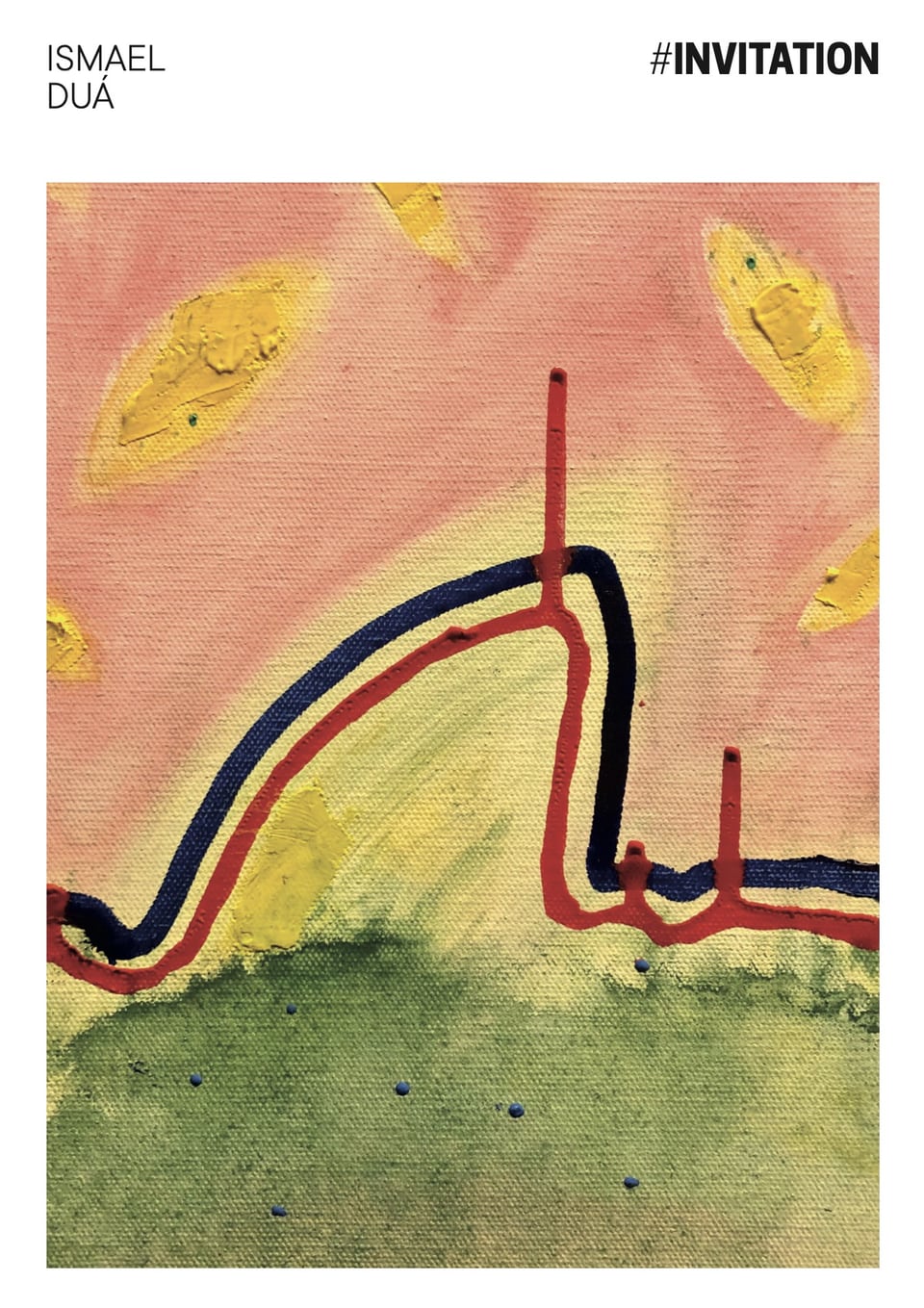
Ismael Duá has committed himself to a format. Since 2006 the Berlin-based artist has worked exclusively in the DIN A4 format. It was a long road, however, to this uniform standard, which was published on 18 August 1922.
For Duá it was a decision, and today the norm is for him both subject and research tool – not only on paper.
From studies in multiple materials, his work has in recent years wrapped itself around a core of painting. The uniform limitation to the smallest of spaces makes possible an exploration of patterns, attitudes and weighting. In depth, the individual picture – through its equal place in the body of work as a whole – is free.
“Everything in the world” interests Ismael Duá, who first studied international politics in Wales and then fine art in Munich. Under Professor Andreas von Weizsäcker he discovered his preference for small formats, under Professor Magdalena Jetelová the uncompromising eye for the whole – and thanks to Professor Jean-Marc Bustamante he found his way back to painting.
Ismael Duá was born in Berlin in 1981; his second home is Conakry, Guinea. He now lives in Neukölln, where, alongside his artistic work, he runs a small restaurant. There, on Karl-Marx-Platz, he curated the project “KAPi TAL” for ten years – a format specialising in artist talks.
-
- Dates
- 19 Jun – 3 Aug 2025
- Venue
- GALERIE 15, Kuno-Fischer-Straße 15/Suarezstrasse 31, 14057 Berlin
- Series
- From the collection
- Artists
- Werner Brunner
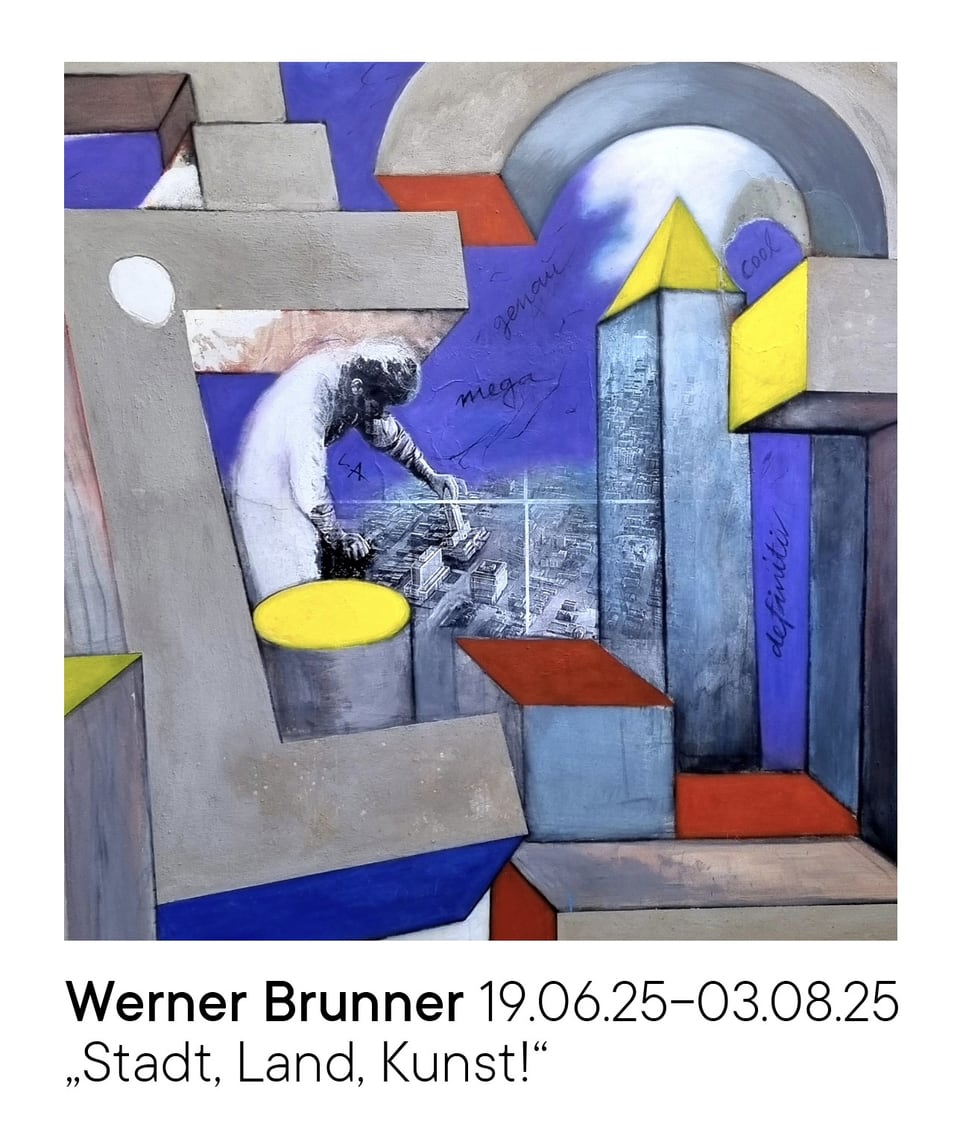
The choice of title “Stadt, Land, Kunst!” reflects the thematic richness and comprehensive oeuvre of Werner Brunner, an artist who lives and works in Berlin. And his biography is as varied as his work: born in Munich in 1941, a trained blacksmith from Oberammergau, aircraft mechanic, active as an architect and in archaeological building research. Even before his trade as a blacksmith, art, architecture and archaeology had been Werner Brunner's desired professions. After studying architecture and working as an architect, however, he could not identify with the architecture of the 1960s and 70s and opened himself up towards art. In Berlin in 1977, with the founding of the “Künstlergruppe Ratgeb” (in memory of Jörg Ratgeb, a contemporary of Albrecht Dürer), Werner Brunner became a professional artist. Alongside studio work, the group's great success soon came with mural painting, to which Brunner also devotes himself as an author and publicist.
At the same time, further pictorial themes soon developed for Brunner in the studio, such as architecture in city and countryside, space and ornament, the post-war period, or the Ark and Atlas.
Brunner's biography and professional background determine his work. He repeatedly examines the tension between human beings and their lived environment and thus finds his creative expression. He uses newspaper reports, photographs, statistical diagrams and quotations, assembles and overpaints his material, lets it disappear into the grand painterly expression or flash up or shimmer through ironically (occasionally also maliciously).
A selection of Brunner's paintings and collages with a thematic focus on city, countryside and architecture will now be on view from 19 June to 3 August at Galerie 15 in Charlottenburg.
-
- Dates
- 10 Apr – 1 Jun 2025
- Venue
- GALERIE 15, Kuno-Fischer-Straße 15/Suarezstrasse 31, 14057 Berlin
- Series
- From the collection
- Artists
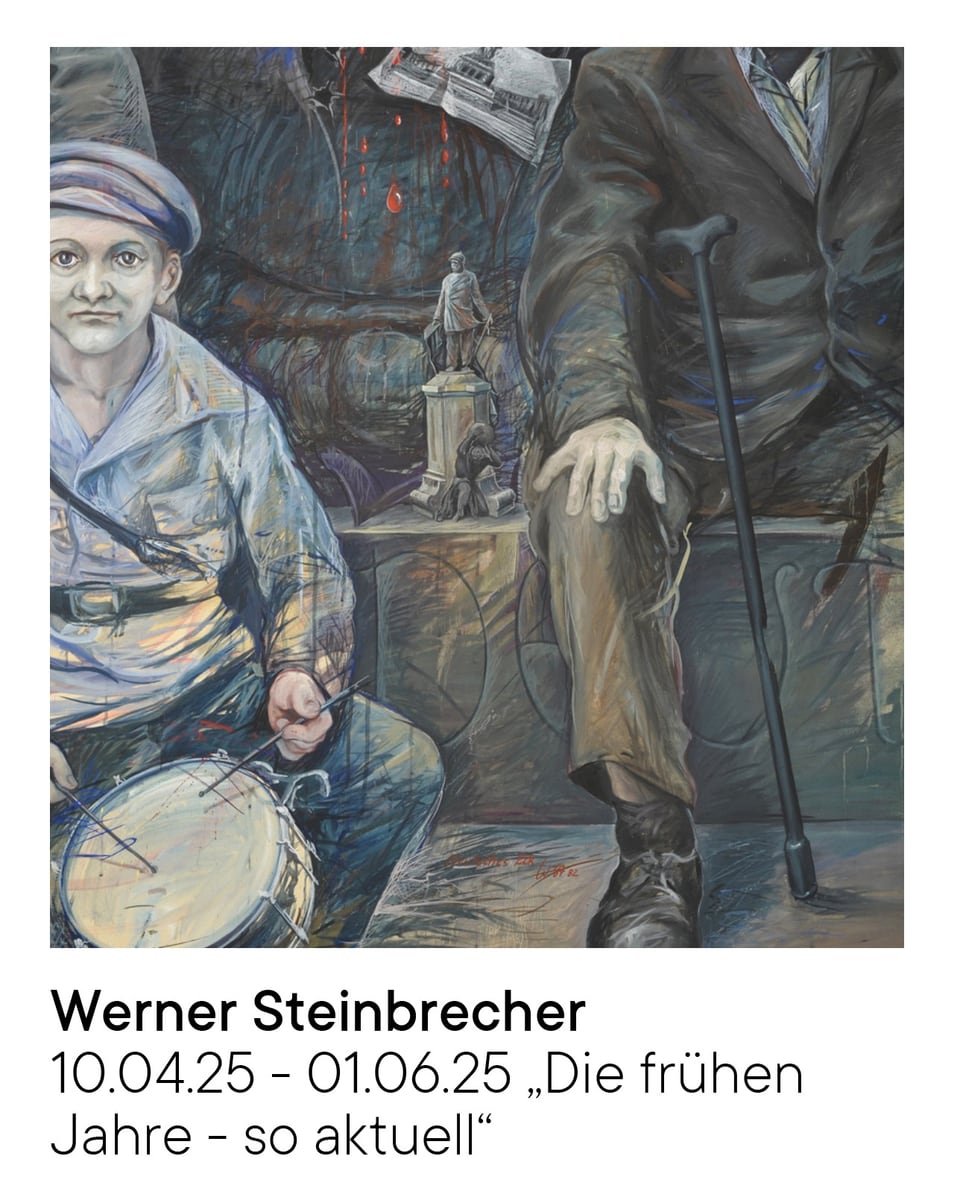
- Werner Steinbrecher
Works by Werner Steinbrecher, born in 1946 in Visbek in Lower Saxony and raised in Düsseldorf, can now finally be seen in Berlin again. He spent 15 years in the former western part of the city – painting, drawing, thinking, questioning – before moving to the countryside in 1989, to Allenbostel near Uelzen, in search of calm, meditation and a time out. He first studied architecture in Aachen and later art at the art academies in Nuremberg and Berlin, and taught as a lecturer at institutions including the University of Lüneburg. His works were shown in numerous exhibitions throughout his life, and many of them can still be seen today in public spaces and museums such as the Berlinische Galerie. In 2008 Werner Steinbrecher died far too early in Bardowick.
Whether during his studies at HdK Berlin, in the studio at his artistic work, in friendships and conversations – Werner Steinbrecher sought depth and meaning. Despite the impressive range of themes in his works, he never merely scratches the surface. In content as in technique, he displayed enormous meticulousness throughout his life. He was a gifted artist who constantly questioned, in his art, his own self, his environment and the effect of art on society and other people.
In his initially large-format oil paintings, Werner Steinbrecher responded to the development of the social and political situation of the 1960s to 1980s: the Vietnam War, the student revolt, the Red Army Faction (RAF) and the “Deutscher Herbst”, as well as the beginnings of environmental activism and feminism.
-
- Dates
- 13 Feb – 31 Mar 2025
- Venue
- GALERIE 15, Kuno-Fischer-Straße 15/Suarezstrasse 31, 14057 Berlin
- Series
- From the collection
- Artists
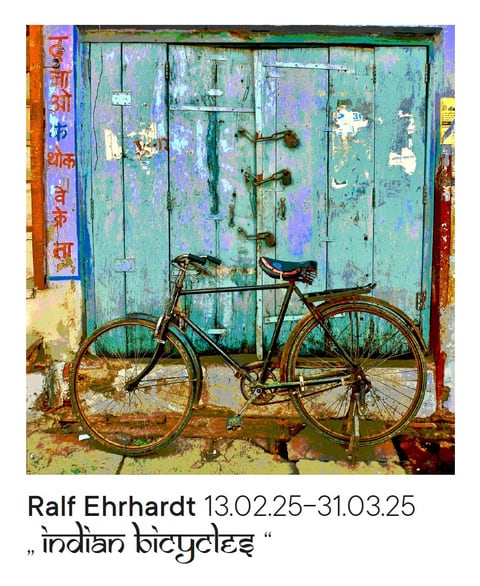
- Ralf Ehrhardt
-
- Dates
- 12 Dec 2024 – 28 Jan 2025
- Venue
- GALERIE 15, Kuno-Fischer-Straße 15/Suarezstrasse 31, 14057 Berlin
- Series
- INVITATION series
- Artists
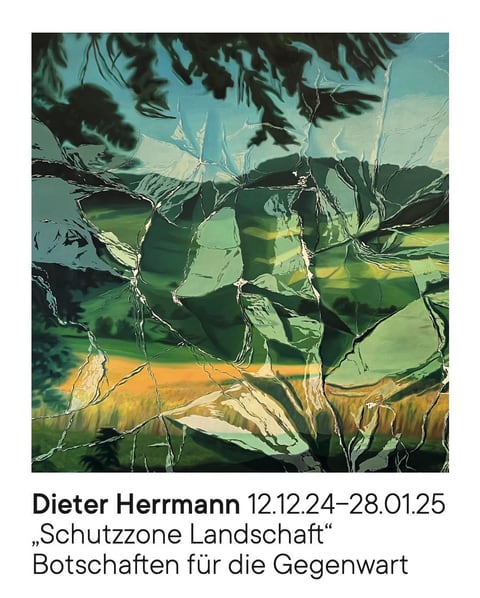
- Dieter Herrmann
-
- Dates
- 17 Oct – 1 Dec 2024
- Opening
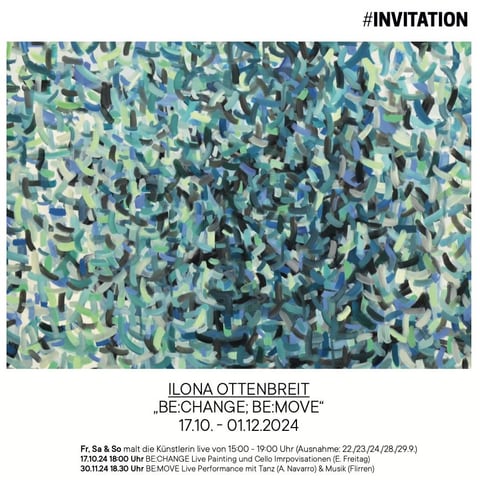
- 17 October 2024, 6 pm – BE:CHANGE live painting and cello improvisations (E. Freitag)
- Closing event
- 30 November 2024, 6:30 pm – BE:MOVE live performance with dance (A. Navarro) & music (Flirren)
- Opening hours
- Fri, Sat & Sun the artist paints live from 3–7 pm
- Venue
- GALERIE 15, Kuno-Fischer-Straße 15/Suarezstrasse 31, 14057 Berlin
- Series
- INVITATION series
- Artists
- Ilona Ottenbreit
-
- Dates
- 5 Sep – 13 Oct 2024
- Venue
- GALERIE 15, Kuno-Fischer-Straße 15/Suarezstrasse 31, 14057 Berlin
- Series
- INVITATION series
- Artists
- Pedro Reis de Mendonça
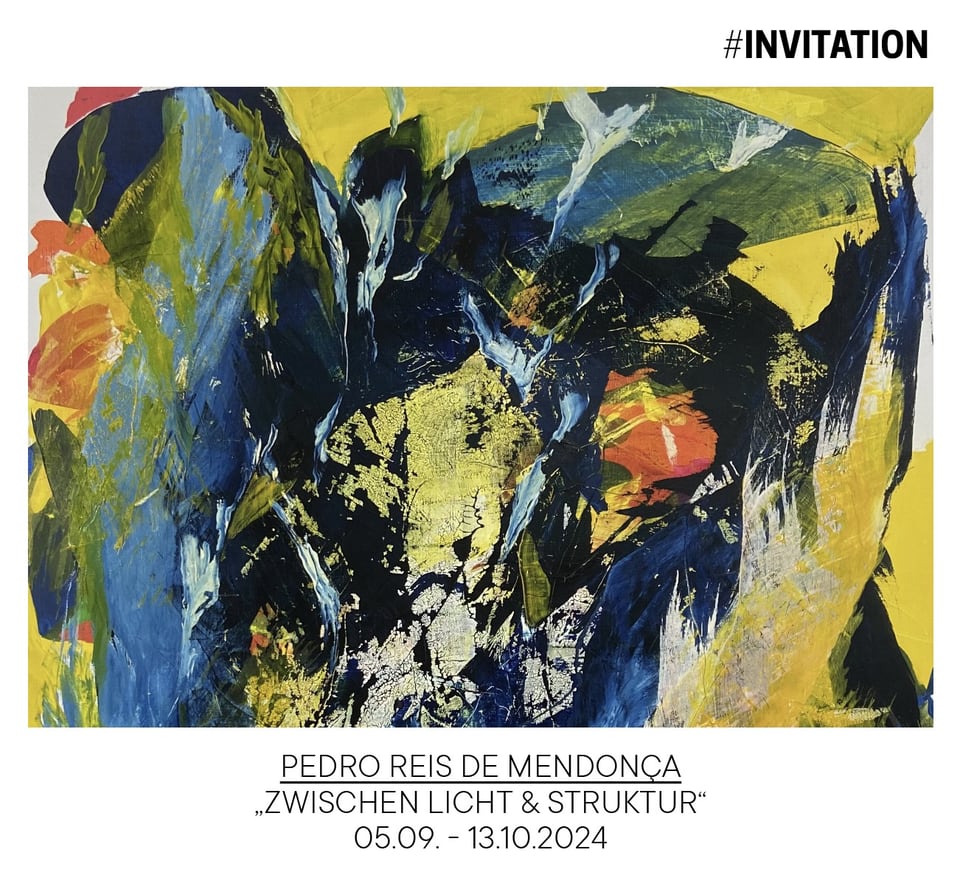
Pedro Reis de Mendonça opened the #INVITATION series in September 2024 with his exhibition “Zwischen Licht und Struktur”. Like the shimmering of treetops or water surfaces in light and wind, his paintings build up layer by layer. With small, repeated gestures reminiscent of music, the artist – born in Rio de Janeiro and living and working in Berlin – applies colours taken straight from the tube. For him, forgoing the mixing of oil paints has the appeal of a permanently reliable palette whose components also retain their clarity and luminosity.
With each layer, composed of many individual marks, Reis de Mendonça approaches a composition that finds its own stability. Sometimes large-format on canvas, sometimes small-format on fibreboard – each with its own aesthetic. Besides the resistance of the painting ground, the fibreboards also offer the possibility of creating freer formats. To these MDF shapes he not only adds paint but also removes it, working lines, structures and patterns into them with a Dremel. The panels created in this way, which are also suitable for relief printing techniques, have led him to printmaking. Since he prints without a press, the prints are made on delicate paper.
-
- Dates
- 27 Jun – 11 Aug 2024
- Venue
- GALERIE 15, Kuno-Fischer-Straße 15/Suarezstrasse 31, 14057 Berlin
- Series
- From the collection
- Artists
- Volkmar Förster
-
- Dates
- 16 May – 23 Jun 2024
- Venue
- GALERIE 15, Kuno-Fischer-Straße 15/Suarezstrasse 31, 14057 Berlin
- Series
- From the collection
- Artists
- Paul Blankenburg
-
- Dates
- 7 Mar – 14 Apr 2024
- Venue
- GALERIE 15, Kuno-Fischer-Straße 15/Suarezstrasse 31, 14057 Berlin
- Series
- From the collection
- Artists
- Werner Brunner
-
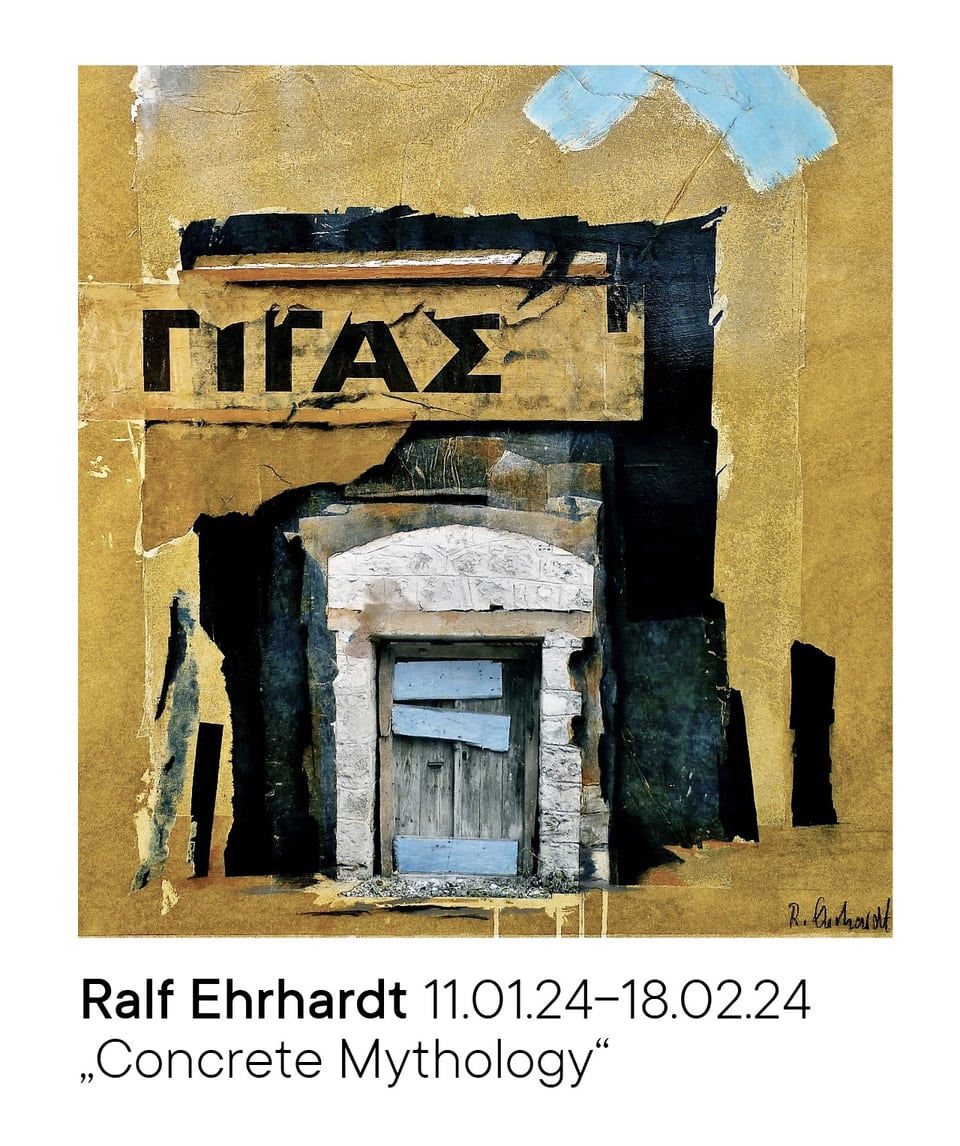
- Dates
- 11 Jan – 18 Feb 2024
- Venue
- GALERIE 15, Kuno-Fischer-Straße 15/Suarezstrasse 31, 14057 Berlin
- Series
- From the collection
- Artists
- Ralf Ehrhardt
-
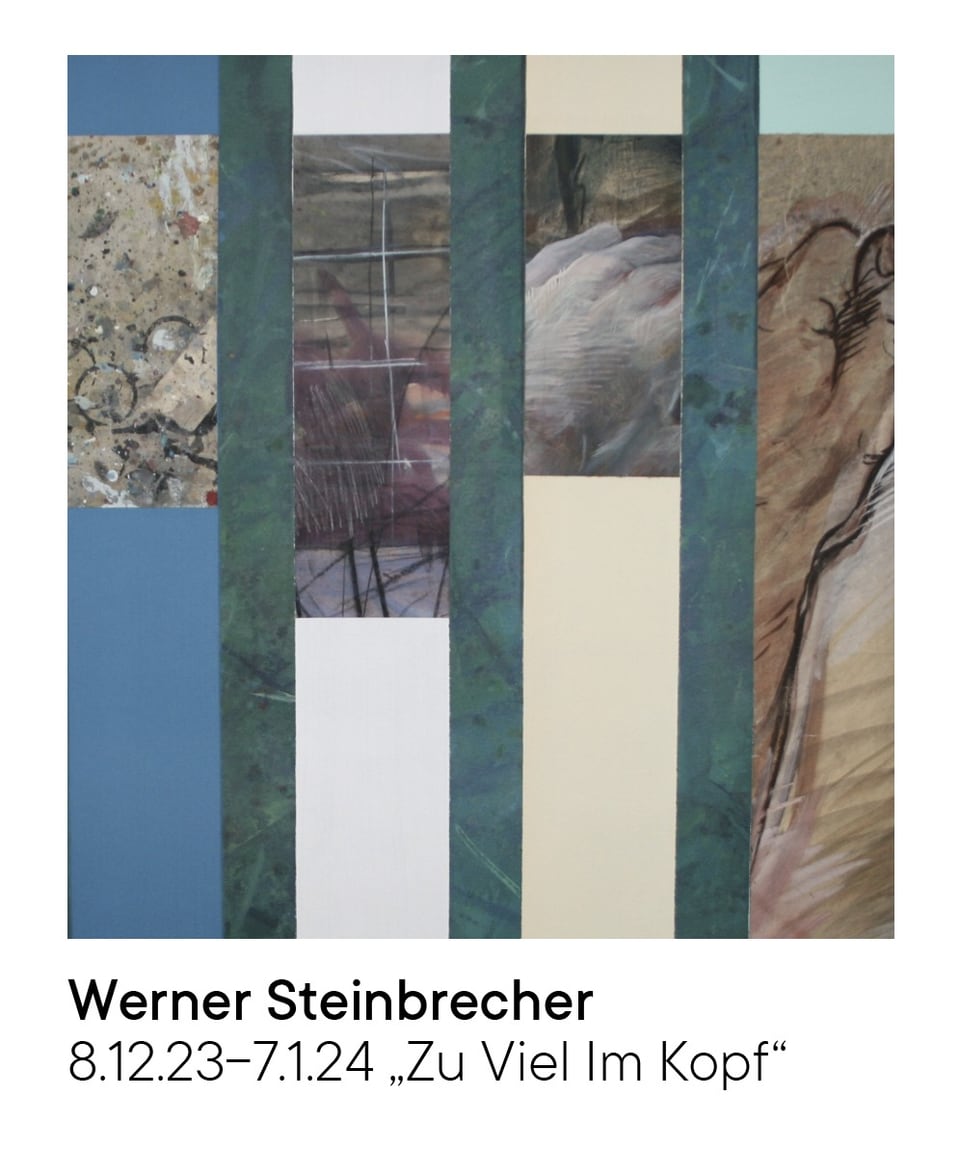
- Dates
- 8 Dec 2023 – 7 Jan 2024
- Venue
- GALERIE 15, Kuno-Fischer-Straße 15/Suarezstrasse 31, 14057 Berlin
- Series
- From the collection
- Artists
- Werner Steinbrecher
-
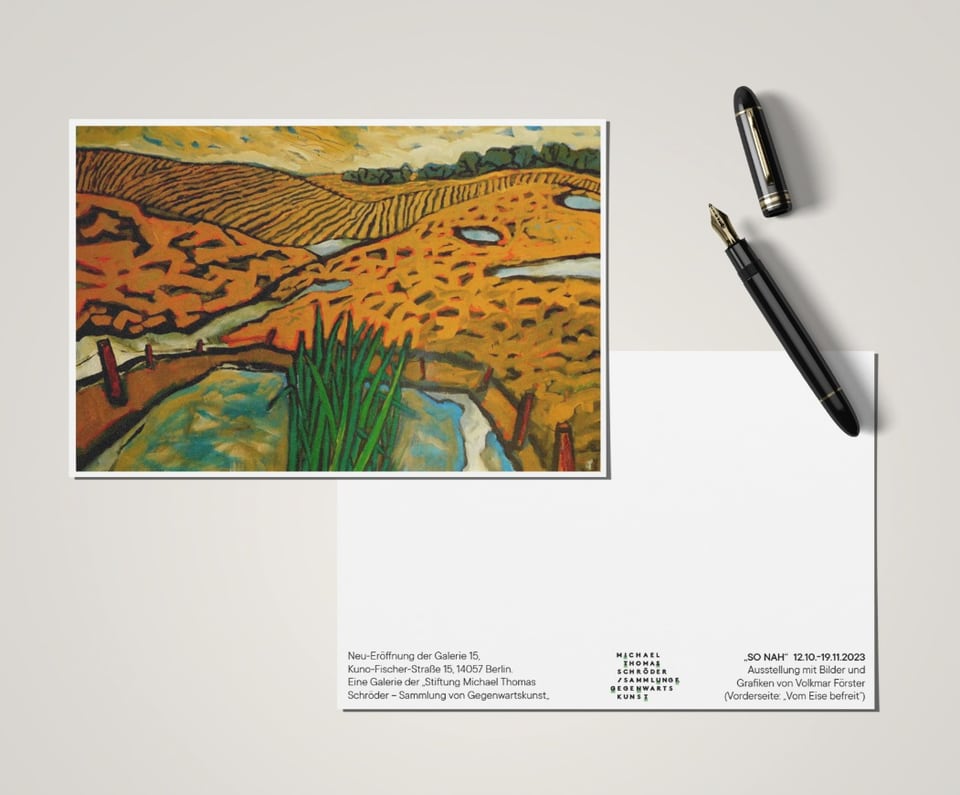
- Dates
- 12 Oct – 19 Nov 2023
- Venue
- GALERIE 15, Kuno-Fischer-Straße 15/Suarezstrasse 31, 14057 Berlin
- Series
- From the collection
- Artists
- Volkmar Förster


More about INVITATION
The exhibition series for guests from outside the collection
INVITATION is an exhibition series of the “Stiftung Michael Schröder – Sammlung für Gegenwartskunst”. It presents inspiring artists who fit the Foundation's profile and are part of the current art scene. Not mainstream but courage is at the heart of this exhibition series.
At irregular intervals the Foundation presents young artists who on the one hand are seeking a path into the public eye and on the other hand fit the Foundation's profile.
Guests so far
- Pedro Reis de Mendonça
- Ilona Ottenbreit
- Ismael Duá
- Anne Dérian
- Oliver Arendt
- Tabea Ćubelić
- Fritz Poppenberg
- Julia Werhahn
GALERIE 15


GALERIE 15 is located at Suarezstrasse 31 in Berlin-Charlottenburg, a few steps from Lietzensee. This is where the foundation shows its collection and presents guests in its INVITATION series.
The gallery is open on Saturdays and Sundays from 1–4 pm. At other times, the gallery can also be visited on weekdays via Café KUNO15.
Directly adjoining the gallery is Café KUNO15. A visit can therefore be combined with a cup of coffee on any weekday – art and culinary pleasure at one address.
Address & Getting there
Kuno-Fischer-Straße 15/Suarezstrasse 31
14057 Berlin-Charlottenburg
Kuno-Fischer-Straße 15/Suarezstrasse 31, 14057 Berlin-Charlottenburg, near Lietzensee.
Opening hours
- Saturday and Sunday
- 1–4 pm
- staffed by the Foundation
- Monday to Friday
- during the café's opening hours
- access via Café KUNO15
Art Consulting
The foundation advises you on furnishing your private or business premises with art.
Has a work from the foundation's holdings caught your interest? Then please get in touch at michaelthomas.schroeder@mts-stiftung.de.
Contact request
Leave your contact details and the foundation will get in touch with you.
Thank you. Your request has reached the foundation.
Unfortunately that did not work. Please check your details or write directly to michaelthomas.schroeder@mts-stiftung.de.